




How West Ham Got Here: Bowen Saw It Coming
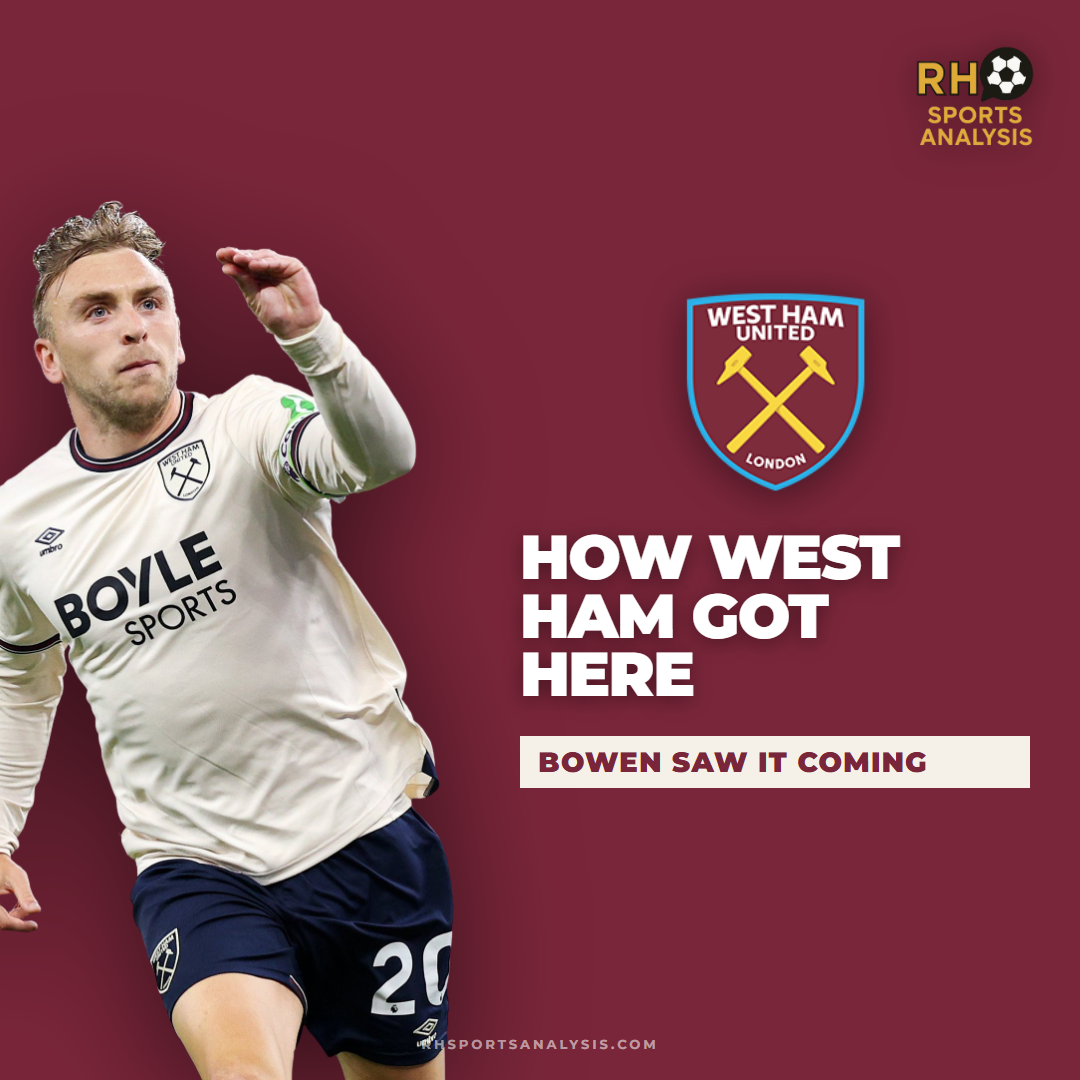
Jarrod Bowen spoke on Tuesday night, five days before the final day of West Ham's Premier League season, and admitted what the underlying numbers had said since February 2024.
“It's not like this season has just come straightaway. It was starting to creep in a little bit last season. But we thought we'd be better this season.”
— Jarrod Bowen, five days before West Ham went down
The captain was being honest about a decline he had seen coming. West Ham beat Leeds 3-0 on Sunday and were relegated 10 minutes later, when João Palhinha's 43rd-minute header at the Tottenham Hotspur Stadium held up to confirm Spurs's survival. Bowen's analysis was already true on Tuesday. It had been true for more than two years. By the 20th of February 2024, with 25 Premier League games played in David Moyes's final season, West Ham had the third-worst expected-goals-against in the division. Only Luton and Sheffield United were worse. Moyes's team finished ninth.
Two years and three head coaches later, here they are.
Already a bottom-three side in February 2024
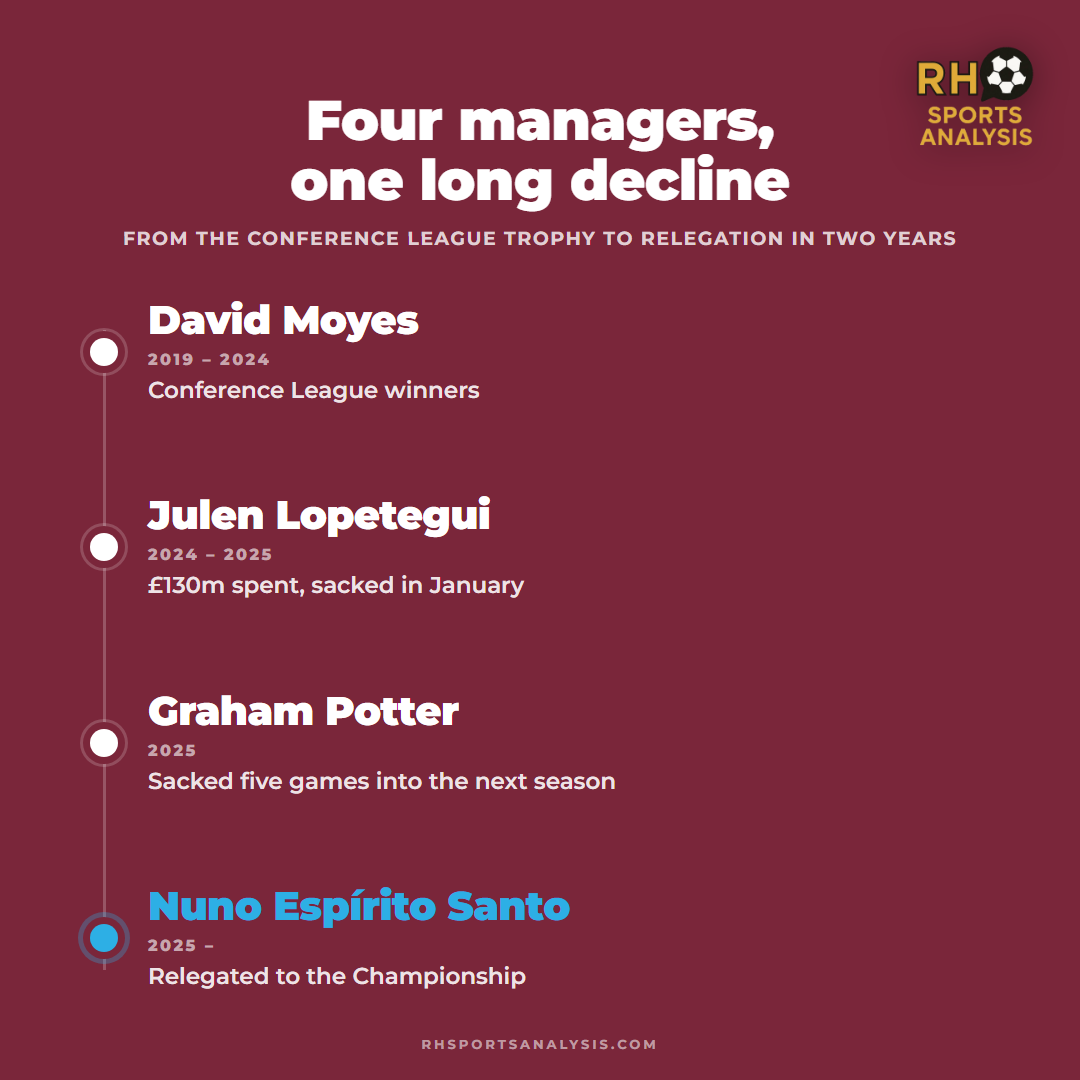
Three summers ago, West Ham won the UEFA Europa Conference League. It was their first major trophy in 43 years, and Bowen scored the winner against Fiorentina in Prague in the last minute of the final. 12 months later David Moyes left the club, replaced by Julen Lopetegui.
By the 20th of February 2024, only Luton and Sheffield United had a worse expected goals against in the division, and both went down that season. Burnley, a fraction behind in fourth-worst, went down too. West Ham finished ninth on actual points, propped up by a top-five finishing efficiency that the underlying numbers could not see.
On the 11th of February, Arsenal won 6-0 at the London Stadium. It was West Ham's first six-goal home league defeat since Boxing Day 1963. From the turn of the year through to the end of the season, Moyes's side won 4 of 23 matches across all competitions. On a league table starting from Christmas, West Ham would have finished 17th.
Kaveh Solhekol wrote the line on the day Moyes's departure was announced.
“After the hundreds of millions spent on players throughout Moyes's second spell in charge, West Ham felt no manager could have survived results over the past five months, unless you accept you are a bottom three side.”
— Kaveh Solhekol, on the day Moyes's departure was announced
A chief football reporter was calling West Ham a bottom-three side at the time, under the trophy-winning manager. The decline was not a hindsight argument.
Hundreds of millions and nine new players
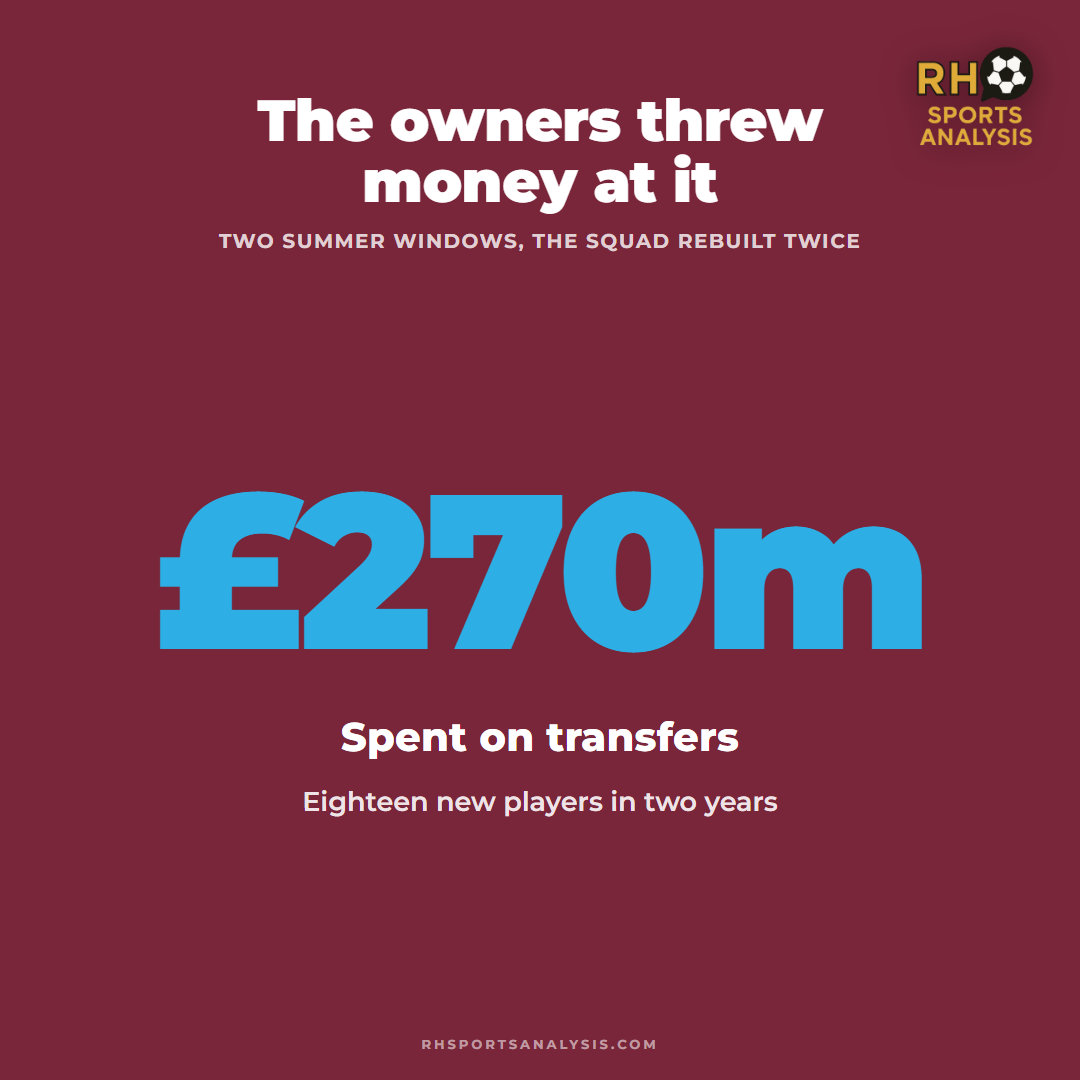
Julen Lopetegui was given more than £130m to spend in his first summer at West Ham. He spent it on nine signings, of whom only one was a personal choice. Max Kilman, the centre-back Lopetegui had worked with at Wolves, was his. The rest were Tim Steidten's. The technical director who picked them was the same man David Moyes had banned from the West Ham dressing room and training ground in the final months of his own tenure.
The nine signings, summer 2024
More than £130m spent. Kilman was the head coach's pick. The other eight were Steidten's.
| Player | From | Type | Picked by |
|---|---|---|---|
| Max Kilman | Wolves | £40m | Lopetegui |
| Niclas Füllkrug | B. Dortmund | £27m | Steidten |
| Crysencio Summerville | Leeds | Permanent | Steidten |
| Luis Guilherme | Palmeiras | £19.4m | Steidten |
| Aaron Wan-Bissaka | Manchester United | Permanent | Steidten |
| Jean-Clair Todibo | Nice | Loan | Steidten |
| Carlos Soler | PSG | Loan | Steidten |
| Guido Rodríguez | Real Betis | Free | Steidten |
| Wes Foderingham | Sheffield United | Free | Steidten |
Lopetegui's brief, as Paul Gilmour wrote later, was to “integrate nine new signings, some with no experience at the highest level, change the system they were playing in to create more chances and win games on a more consistent basis.” He was being asked to solve a structural problem with a squad he had not been allowed to build.
The numbers held what the structure could not. West Ham conceded an average of 2.10 expected goals against per game across Lopetegui's 20 Premier League matches. That is not a Premier League number, it is a Championship-bound number, and it sat on top of the bottom-three baseline Moyes had already established the season before.
The dressing room turned next. At half-time of a 2-5 home defeat to Arsenal at the end of November 2024, Lopetegui and Jean-Clair Todibo, the French defender on loan from Nice, had what Roshane Thomas reported turned physical. Sami Mokbel described it as “an intense verbal dispute.” Lopetegui's deflection at the next press conference, asked about the incident: “The things that happen in the dressing room have to stay in the dressing room. Always. Nothing important happened.”
Five weeks later the West Ham board met to decide whether to sack him. Rob Dorsett reported the board split 60-40 over whether to axe him after a 3-1 home defeat to Leicester on the night Ruud van Nistelrooy took the Foxes dugout for the first time. Lopetegui won the next game against Wolves, then won only once in his next five. After a 4-1 defeat at Manchester City on the 4th of January 2025, he was sacked four days later. He left with 23 points from 20 Premier League matches and West Ham 14th, seven points above the relegation zone.
Different coach, same trap
Graham Potter was appointed the day after Lopetegui's exit. He brought Kyle Macaulay with him as Head of Recruitment, and less than a month into his tenure the club issued a statement confirming Tim Steidten's departure. The wording was unusually frank.
“With the arrival of our new Head Coach Graham Potter, who has brought in his own Head of Recruitment, it is time for Tim to pursue new opportunities.”
The recruitment-versus-management split looked over. Then the ownership group spent another £137m on nine signings in the summer of 2025. Mohammed Kudus departed for Tottenham for £54.5m. Edson Álvarez, who had fallen out with Potter, went on loan to Fenerbahçe.
Potter's summer 2025: nine signings, £137m
Same recruitment volume, different head coach.
| Player | From | Fee |
|---|---|---|
| Mateus Fernandes | Southampton | £42m |
| Jean-Clair Todibo | Nice | £36.3m (loan→perm) |
| El Hadji Malick Diouf | Slavia Prague | £23m |
| Mads Hermansen | Leicester | £18m |
| Igor Julio | Brighton | Permanent |
| Callum Wilson | Newcastle | Free |
| Kyle Walker-Peters | Southampton | Free |
Plus two further additions to reach the nine-signing total.
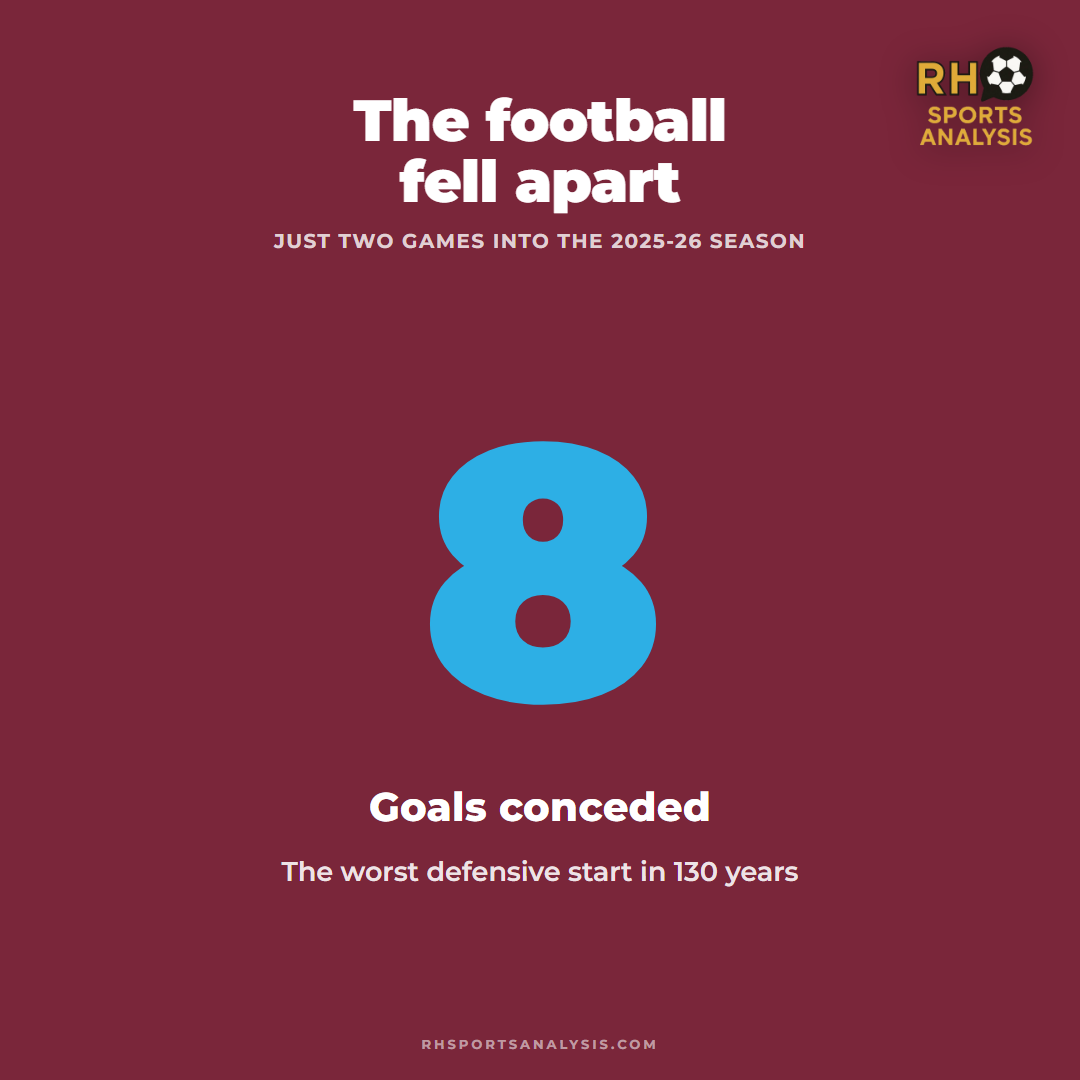
West Ham opened the new season with eight goals conceded across two matches, against Sunderland away and Chelsea at home. By Opta's count it was the worst defensive start to a top-flight season in the club's 130-year history. Five matches later, Potter was sacked. He left with the worst win rate of any permanent West Ham manager in the club's history. Same ownership, same recruitment volume, different head coach, same outcome.
Fifteen goals from corners, in both directions
Across the four seasons from the Conference League trophy to this final day, West Ham have conceded 10, 16, 15 and 22 goals from set pieces in the Premier League. The total this season is joint-worst in the division, level with Bournemouth. 15 of those 22 have come from corners, more than any other Premier League team this season on the per-shot data tracked by Understat.
Arsenal have scored 15 goals from corners this season, by the same per-shot measure. The same number that West Ham have conceded, in the opposite direction.
Mikel Arteta appointed Nicolas Jover as Arsenal's set-piece coach in July 2021. Jover, a French coach who had previously worked alongside Arteta at Manchester City under Pep Guardiola, has built Arsenal's dead-ball operation into the most prolific in football. In 2024-25, his team scored more goals directly from set pieces than any other side in the Premier League. Gary Neville: “He's a little nuisance, that set-piece coach, but he's damn good.”
West Ham have appointed no equivalent across three head coaches. The share of their goals against that arrive from a dead ball has risen from 18.5 per cent in the trophy season to 35.5 per cent this season. Each manager has been worse than the previous on the same coachable failure.
0
Share of West Ham’s goals against from set pieces this season, up from 18.5% in the Conference League trophy year. Three head coaches, no set-piece appointment, each worse than the last.
The problem was visible. The fix was not appointed.
The fourth manager
Nuno Espírito Santo was the fourth head coach the West Ham ownership had appointed in 16 months when he walked into Rush Green on the 27th of September. Jorge Mendes brokered the deal. Sullivan and Kretinsky agreed to a three-year contract. The brief was the same brief that had broken Lopetegui and broken Potter. The defence was conceding almost three goals a game and had let in seven from set pieces in the season's first five matches.
Nuno's first months were the worst start to a top-flight season any West Ham team had ever made. By the 20th of October they had lost their first four home league games of a season for the first time in the club's history.
A January transfer window followed in which West Ham bought four players.
Nuno's January 2026 window
Three permanent signings and one loan.
| Player | From | Fee |
|---|---|---|
| Taty Castellanos | Lazio | £25.2m |
| Pablo Felipe | Gil Vicente | £20m |
| Adama Traoré | Fulham | £1m + £1m |
| Axel Disasi | Chelsea | Loan |
The form changed quickly. West Ham drew at Crystal Palace, thumped Wolves 4-0 with two Konstantinos Mavropanos goals on his return from injury, and climbed out of the relegation zone for the first time since matchday four. Between mid-January and early April, only six Premier League sides scored more goals per game.
Then May happened. West Ham hit the woodwork four times in a 3-0 defeat at Brentford on the 2nd of May. They had a Callum Wilson equaliser disallowed at home to Arsenal after a multi-minute VAR check Gary Neville on co-commentary called “the biggest moment in VAR history.” They lost 3-1 at Newcastle with a Hermansen-Todibo mix-up gifting the first goal and a Disasi defensive lapse the second.
On Tuesday night, Chelsea beat Tottenham at Stamford Bridge to keep West Ham's hopes alive on goal difference. Sunday at the London Stadium, Castellanos headed in a Bowen corner in the 67th minute, Bowen drilled across Karl Darlow in the 79th, and Callum Wilson finished in stoppage time. Ten minutes after full time, the Tottenham result held. Spurs had beaten Everton 1-0. West Ham were down.
A liquidity shortfall in Summer 2026
On the 17th of December 2025, PwC signed off West Ham United's accounts for the year ended the 31st of May 2025. The pre-tax loss was £104.2m, the largest in the club's history. The audit was clean. It was clean because of one sentence under Note 1b on page 36 of the filing.
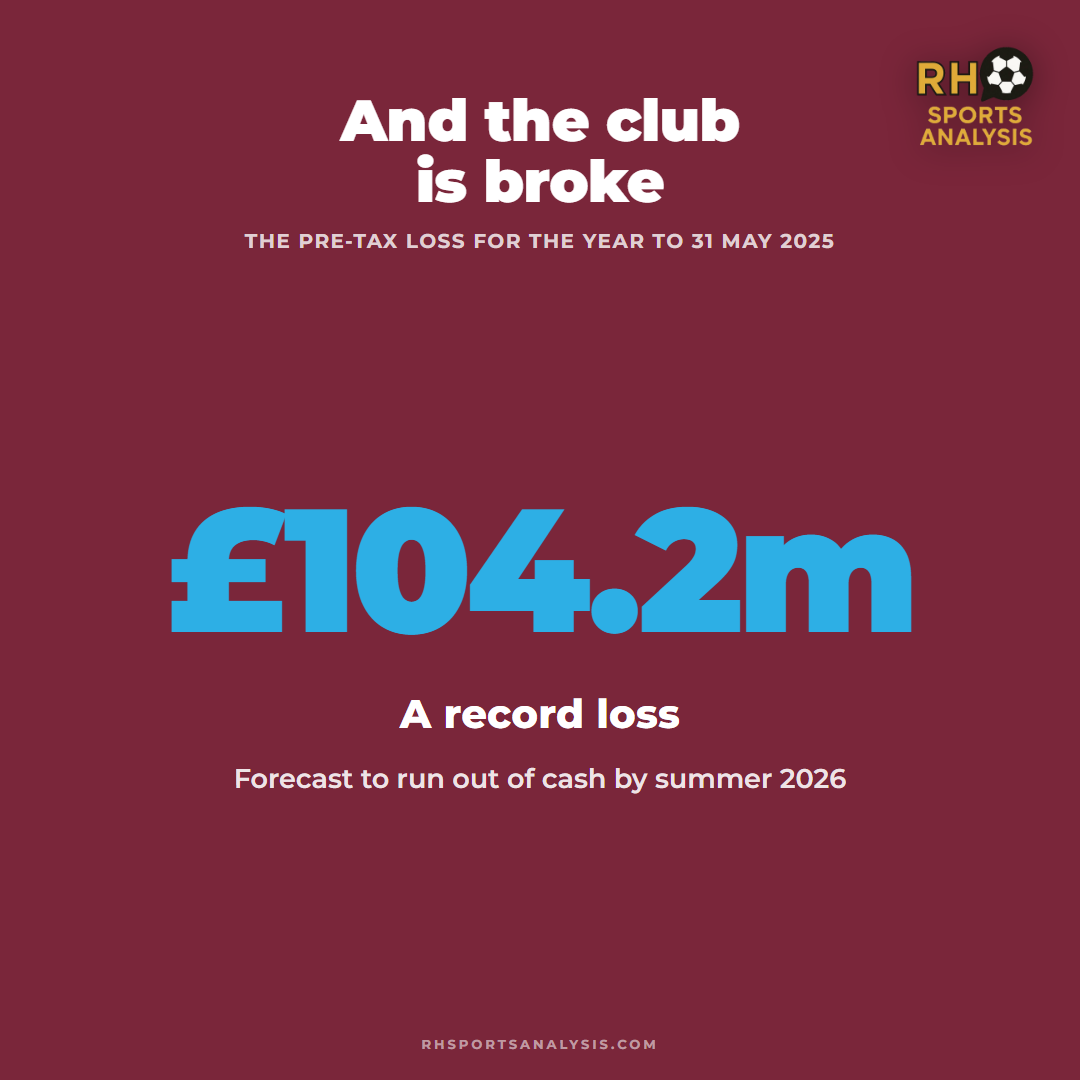
“Under the base forecast, within the going concern period, prior to mitigating actions, the Group is forecasting a liquidity shortfall in Summer 2026.”
That is the West Ham board, in their own audited filing, stating that the club is forecast to run out of money this summer. The mitigating actions, the same note explains, are either further player trading and the factoring of transfer-fee receivables, or “additional funding from the shareholders.” Under the relegation scenario, the note continues, “additional shareholder funding will be required.”
PwC signed the audit because, in their own words, “certain of the investing owners have committed jointly, by signing a letter of support, to provide financial support.” That support has to be enough to cover both the normal scenario and the relegation scenario. Without that letter, PwC could not have signed off the accounts.
The two investing owners who would need to write the cheque are David Sullivan and Daniel Kretinsky. Both now hold approximately 40 per cent of the club after buying into the David Gold estate this April.
“Mr. Kretinsky, I think to some people's surprise, hasn't shown the slightest willingness to buy any more of the football club.”
— Christian Purslow, former Liverpool managing director and Aston Villa chief executive
That sentence is the financial story of West Ham's next 12 weeks.
As of Sunday, the relegation scenario is no longer the severe-but-plausible one. It is the live one. The 50 per cent squad-wide salary-reduction clause first reported by Roshane Thomas, written into West Ham's player contracts on relegation, has triggered. The club is reported to be planning to raise between £100m and £150m in player sales this summer.
West Ham paid £22m of interest in 2024-25 and took out a £124m loan from a finance company called Rights and Media Funding, at an estimated 10.25 per cent. They also raised £71.7m by selling future transfer payments they were owed. Instead of waiting for the buying clubs to pay, they handed those payments to financiers and took cash up front.
One of those was a £12.7m payment another club owed West Ham for a player they had sold. West Ham gave up the right to that £12.7m and took £12m in cash from a finance company instead. The audit note called this “accelerated without recourse.” In plain English, they took less money to get it sooner.
The cost of running it this way
West Ham's financial mechanics, FY25.
£15m of West Ham's interest bill came from extended payment terms the club accepted on transfers it had agreed to buy. The cost of running a football club this way is approximately twice that of running it conservatively.
What Bowen could see
Bowen scored the goal that won the Conference League in Prague three summers ago. On Sunday at the London Stadium he was in tears at full time, after a 3-0 win that turned out not to matter. He finished the season with 9 Premier League goals and 11 assists, his most in a single season. Only Paolo Di Canio and Dimitri Payet have more assists in a single West Ham season. The captain has been the constant, and he has been in the decline he saw coming.
Bowen wrote on Instagram on Sunday night:
“Winning that trophy in Prague was the best night of my career. Sunday was the worst.”
— Jarrod Bowen, Instagram, 24 May 2026
On Wednesday, West Ham confirmed Nuno will lead the Championship campaign. David Sullivan reportedly wanted a change. Daniel Kretinsky reportedly wanted continuity. The owner the audited accounts say is most likely to write the next cheque got his way.
West Ham are not just a relegated football club. They are a relegated football club whose audited accounts forecast a liquidity shortfall this summer, whose two owners have given no public commitment to fund it, and whose structural problems are not the kind a Championship campaign will fix.
The audit warned in December that relegation would force the owners to put new money in. On Sunday, relegation happened. The £100m to £150m the club is reported to want from player sales will determine whether the shortfall is closed by football trade or by shareholder cheque.
The conventional story of a relegated Premier League club is that the parachute payments soften the blow, the squad is good enough to compete for promotion, and most come back inside two seasons. None of that is the question for West Ham. The question is whether the owners write the cheque the audit needs by summer. That question is bigger than the football.
Related reading

The Europa Champions Who Cannot Stay Up: How Tottenham Fell Apart
West Ham vs Arsenal Preview: A Title Chase and a Relegation Fight on the Same Pitch
Our members receive data-driven selections across every sport we cover. Are you in?