




The Europa Champions Who Cannot Stay Up: How Tottenham Fell Apart
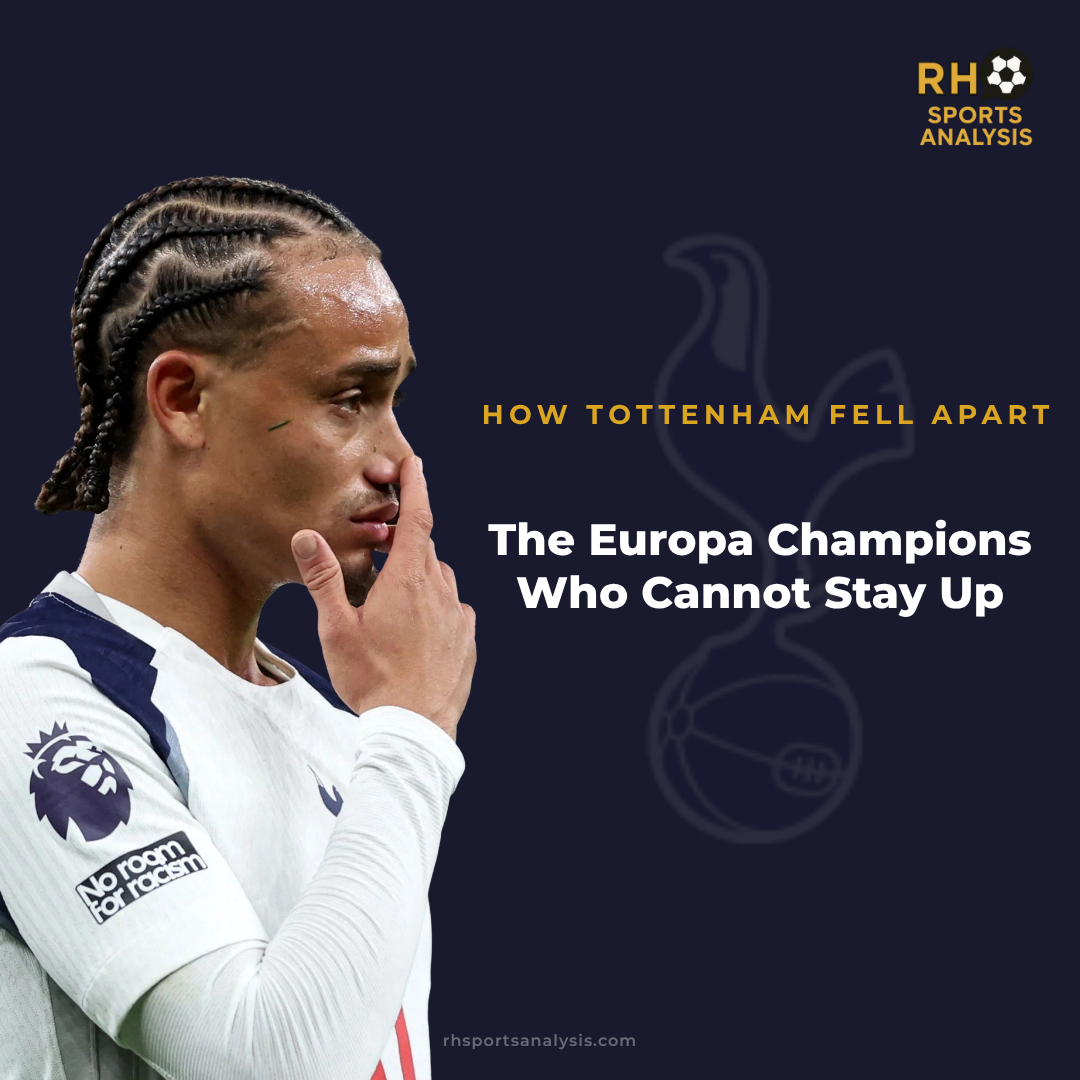
A Tottenham captain held silverware above his head, and for a moment the seventeen years since the last one melted away.
Heung-min Son lifted the Europa League trophy at San Mamés on the 21st of May 2025. The 1-0 win over Manchester United was the third clean sheet of a knockout run that ran through Eintracht Frankfurt and Bodø/Glimt. Across the entire fifteen-game Europa run, Tottenham conceded thirteen goals.
0
Goals conceded across the entire fifteen-game Europa League winning run.
Spurs finished 2024-25 in seventeenth place in the Premier League, with the worst defensive record outside the bottom three, thirteen points clear of relegation only because the bottom three had already given up.
Ange Postecoglou had won Europe and finished seventeenth, and the club's owners had already decided which one mattered more.
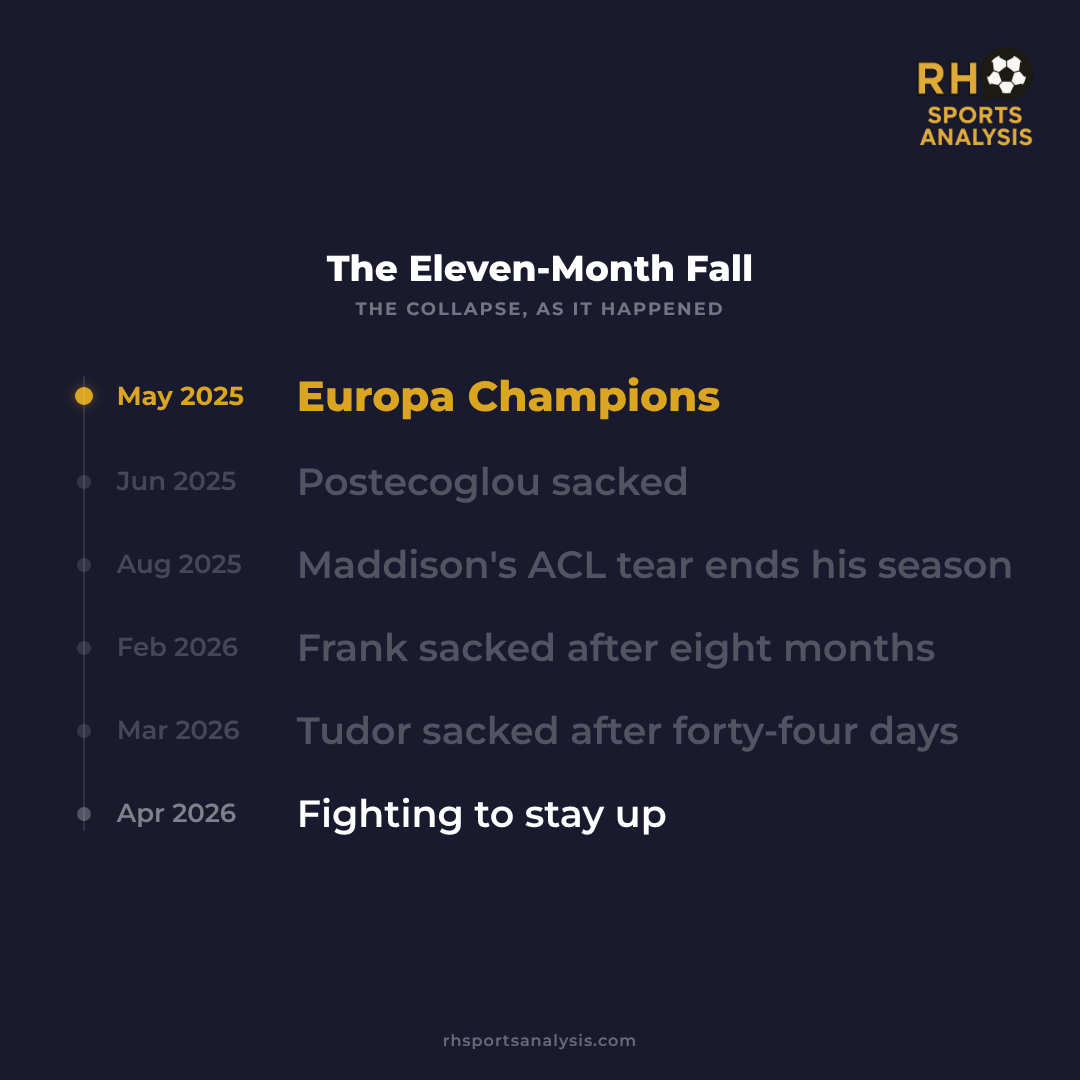
The decision that started it all
Winning a European trophy is supposed to buy a manager time. Postecoglou had won one, and Tottenham's owners sacked him anyway.
The reasoning, when you set the trophy aside, was not complicated. Spurs had finished 2024-25 in seventeenth place with sixty-five goals conceded, the most a Tottenham side had let in across a Premier League season since 1992-93. Postecoglou's high-line, back-four football had produced one of the most extreme split-seasons English football had seen, and the league position was not survivable in the long run. ENIC, the investment group that has owned the club since 2001, made the call that the trophy was a result, not a system, and a system was what the next decade required.
Thomas Frank arrived on the 12th of June 2025 on a three-year contract, with a ten-million-pound compensation fee paid to Brentford. He was the opposite of Postecoglou in almost every way that mattered. Where Postecoglou had a Plan A and only a Plan A, Frank built his Brentford reputation on tactical flexibility, on horses-for-courses formations, on switching profiles in midfield depending on the opponent. Where Postecoglou had conceded sixty-five, Frank's task was to concede fewer.
What he inherited was harder to read.
The first cracks
The opening month suggested Frank had it under control. Spurs beat Burnley 3-0 at home on the opening day, then went to the Etihad and won 2-0 against Manchester City a week later, sitting top of the early Premier League table eight days into the season. A club that had spent the previous campaign conceding sixty-five goals had registered a clean sheet on its biggest away day, and the early evidence pointed to a manager who had walked in and made the defence functional inside two weeks.
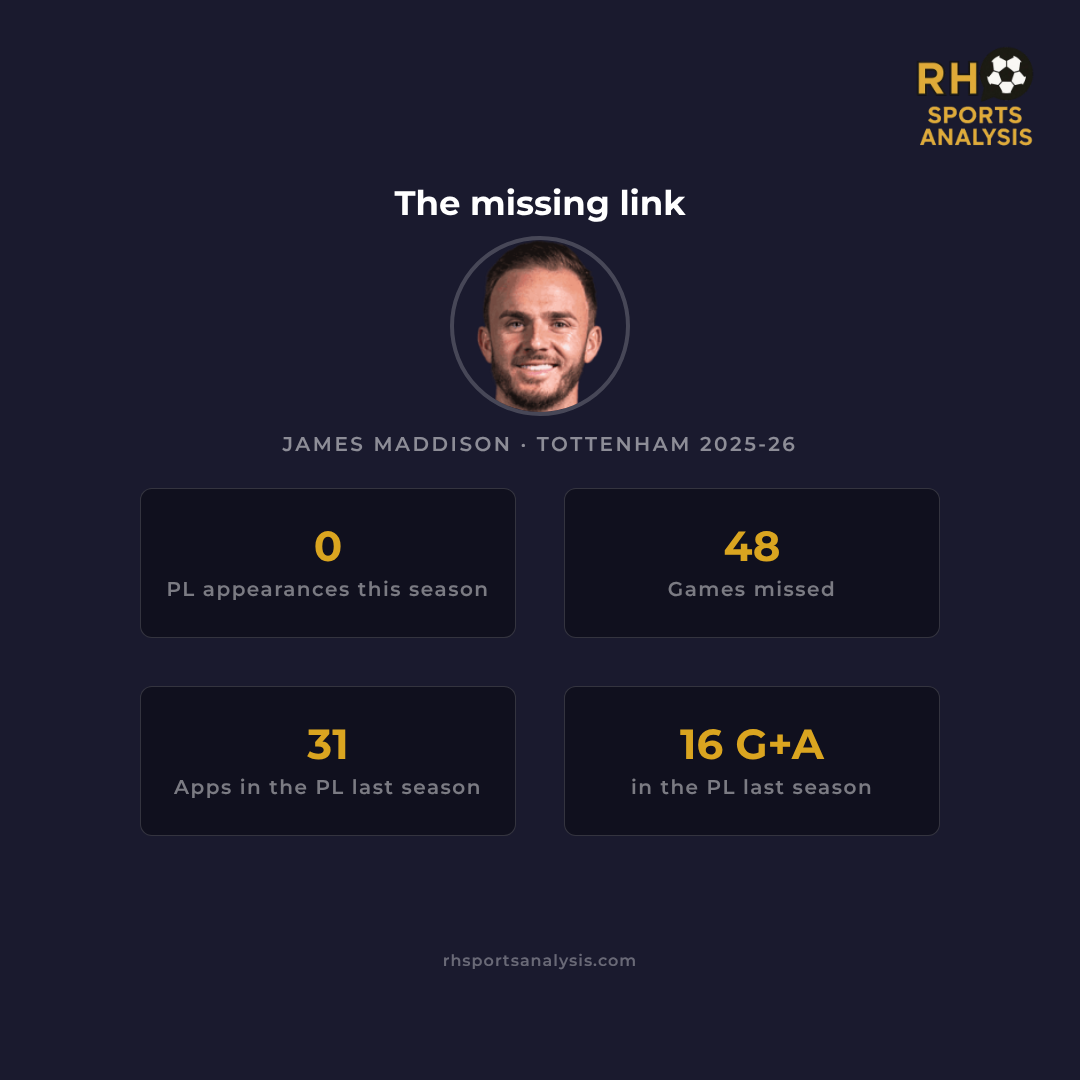
On the 3rd of August, ten days before the Super Cup final against PSG, James Maddison ruptured his anterior cruciate ligament in a pre-season friendly against Newcastle in Seoul, with the club confirming the rupture four days later, which meant Frank's chief creator never made it to his first matchday. Heung-min Son had already left, his contract running down on a club he had given a decade to and his next move taking him to LAFC. The captain's armband fragmented across the squad, eventually being worn by Romero, van de Ven, and even Pedro Porro at points across the season. On the 4th of September, after almost twenty-five years in charge, Daniel Levy resigned as chairman.
Frank had taken the job at a club that had won the Europa League in May, and by September he was managing one without its chairman, without its captain, and without its chief creator. The opening run masked the damage rather than repaired it, and once the fixtures got harder the attacking output stayed thin and the league position began to slip.
Frank's eight months
Frank's tactical brief was the inverse of Postecoglou's, swapping a high line and a fixed back four for a horses-for-courses philosophy that switched formations and midfield profiles depending on the opponent. The early returns suggested the approach worked, with Spurs winning 2-0 away at Manchester City in matchweek two through a hybrid high press and man-to-man marking, and the Champions League run producing five wins from eight league phase games against opposition who came at Tottenham. Against teams who attacked Spurs, Frank's setup was genuinely competitive.
The problem was every other Tottenham fixture. Against domestic sides who sat deep, Spurs could not break them down, attempting four through-balls all season, fewer than any other club in the Premier League and a fraction of Arsenal's forty-three. The home defeat to Chelsea on the 1st of November produced an expected goals figure of 0.05, the lowest a Spurs side had ever recorded in a Premier League match.
0
Spurs' xG figure in the home defeat to Chelsea. The lowest a Spurs side has ever recorded in a Premier League match.
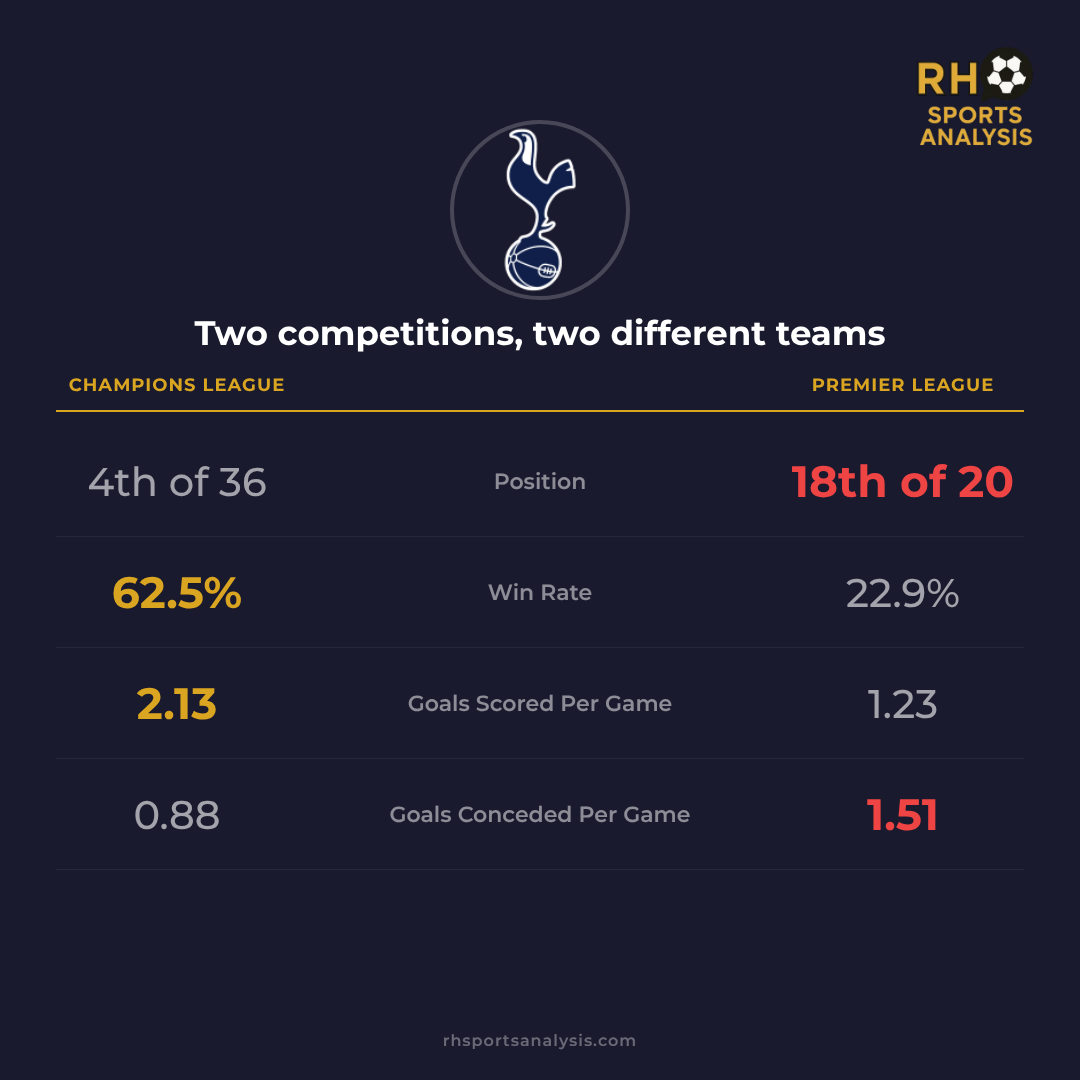
Tottenham had become the second-most prolific crossing side in the league, but the deliveries came from wide and deep positions rather than from progressive central play. The squad lacked the central creativity to do anything else, with Maddison injured for the season, Kulusevski yet to play a minute, and Solanke missing months at a stretch.
The dressing room read what was happening before the table did. After the Chelsea defeat, Micky van de Ven and Djed Spence were filmed snubbing Frank's handshake at full-time, and after the away defeat at Bournemouth on the 7th of January, Van de Ven, Pedro Porro, and João Palhinha had heated confrontations with the travelling support.
Romero went public twice, once on Instagram in the wake of the Bournemouth loss with a post questioning the club's direction, and again in his post-match interview after the home defeat to West Ham on the 17th of January, when he called the situation “a disaster”. A few weeks later, with the January window closed and no reinforcements in, he posted again after the 2-2 home draw with Manchester City, labelling it “unbelievable but true and disgraceful” that the squad had only eleven fit senior players.
Frank had built a small core of leadership around five or six players, and anyone outside that group could go days without a one-on-one conversation with the manager.
Once the leaders began to waver, the rest of the squad followed.
The fans got there at roughly the same time. After the New Year's Day 0-0 at Brentford, the away end chanted “boring, boring Tottenham” and Frank was booed when he went to applaud the travelling supporters. In his press conference the next day, asked whether he was enjoying his time at the club, his answer was “the short answer is no”, and the line that survived was the no.
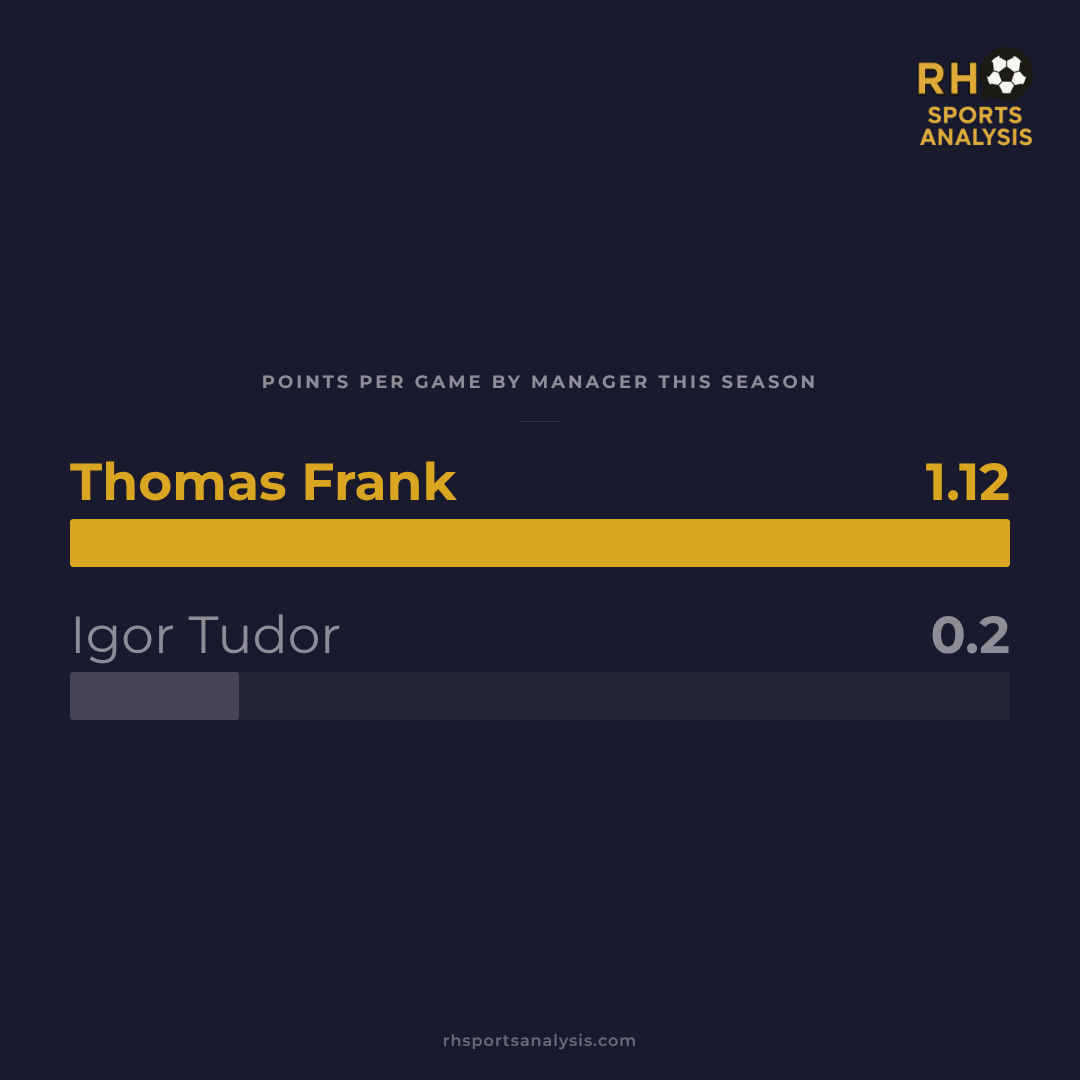
The 1-2 home defeat to West Ham on the 17th of January produced “sacked in the morning” chants and the loudest boos of the season at the Tottenham Hotspur Stadium. Frank managed twenty-six Premier League games in total, won seven of them, drew eight, lost eleven, and finished his time at the club on twenty-nine points. That is 1.12 points per game, the lowest win percentage of any Tottenham manager across ten or more Premier League matches in the club's history at the time of his sacking.
Two of those seven wins came at home all season, his last seventeen league games produced two victories, and his four January fixtures produced none. After the 1-2 home defeat to Newcastle on the 10th of February, with the home crowd in the South Stand chanting Pochettino's name and the stadium audibly turning, Vinai Venkatesham led internal executive-board discussions with the ownership and made the case for a change. Frank was sacked the next morning, one day short of eight months after his 12th of June appointment.
The decision to back the trophy as evidence of a failed system had cost Postecoglou his job, and the decision to replace him with a coach whose strengths could not survive contact with the Tottenham squad cost Frank his.
Tudor's forty-four days
Igor Tudor had been out of work since Juventus sacked him in October 2025, and his appointment rested on a reputation built across brief but high-profile spells at Marseille and Lazio before that Juventus stint. The Tottenham version of that reputation lasted a single match.
His first game was a 1-4 home defeat to Arsenal in a 3-5-2. His second was a 2-1 loss at Fulham, by which point he had abandoned the back three for a four. His third was a 1-3 home defeat to Crystal Palace in a 3-4-2-1, reverting to a back three after the Fulham experiment, the third different formation in three games.
The fourth was the Atlético Madrid first leg, in which Tudor dropped first-choice goalkeeper Guglielmo Vicario and started his backup Antonín Kinsky on his Champions League debut. Kinsky was twenty-two and had not played for the club in five months. He slipped attempting a clearance in the sixth minute for the first goal, and was responsible again in the fifteenth when he miscued a back-pass with his weaker foot for the third, with a Van de Ven slip in between gifting Griezmann the second. Kinsky was substituted after seventeen minutes with Spurs already 3-0 down. The final score was 5-2 and the dressing room read it as a manager who had bet the squad's biggest match on a goalkeeper who had not played since October.
Tudor's seven matches in charge produced one win and one draw across all competitions. The single Premier League point came from a 1-1 at Anfield in which only seven substitutes were available. The single win was the 3-2 home leg against Atlético, which extended the club's unbeaten European home run to twenty-five matches and ended the tie at 7-5 on aggregate. The five Premier League games returned a single point.
0
Days from Tudor's appointment to the mutual-consent termination. Seven matches, one win.
His final match was a 0-3 home defeat to Nottingham Forest in a relegation six-pointer on the 22nd of March. Tudor's father Mario died that same afternoon, and Tudor was told immediately after the final whistle. He flew to Croatia for the funeral, and seven days later, on the 29th of March, both parties agreed to part ways by mutual consent, forty-four days after he had walked in.
The injury crisis underneath
There is a version of this story that ends with the managers, but the data does not let it end there. Frank inherited a squad whose chief creator never made it to the first matchday. By the time Tudor arrived, the same squad had lost two more first-choice forwards, a starting goalkeeper, and a captain.
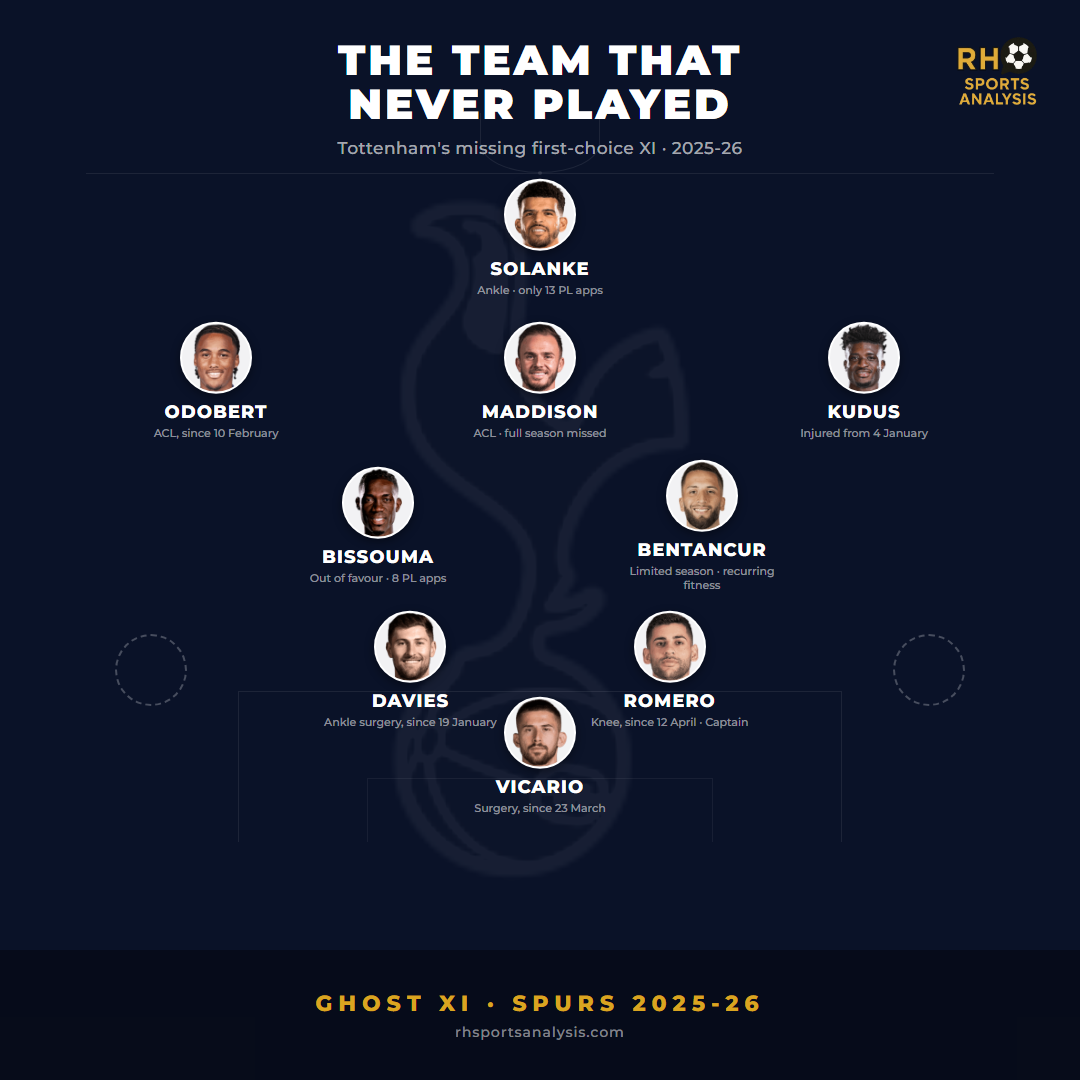
You could, on paper, build a starting eleven entirely out of the absentees. That team did not play a single Premier League minute together. The team that did play was a permanent improvisation.
James Maddison was ruled out for effectively the entire 2025-26 season after his pre-season ACL tear, having played thirty-one Premier League games the previous campaign, and only returned to the matchday squad in April 2026 without playing. Dejan Kulusevski did not play a single Premier League minute all season. Dominic Solanke, the starting striker who had scored nine times for Postecoglou, made eleven Premier League starts across the entire campaign because of an ankle injury that recurred. Mohammed Kudus, a summer signing brought in to add wide creativity, was out from early January onwards. Xavi Simons, the late-August signing who had become one of the few attacking constants of the season at twenty-eight Premier League appearances and nineteen starts, ruptured a cruciate ligament in late April.
The defensive end was no kinder. Ben Davies had ankle surgery in mid-January and missed the bulk of the run-in. Cristian Romero, the captain, picked up a knee injury in mid-April that ended his season. Wilson Odobert tore his ACL in early February. Guglielmo Vicario had surgery in late March. By the time Tudor was forced into the Atlético first leg, the squad had around eleven first-team players unavailable.
Tottenham finished the Frank era as one of the most injury-affected sides in the league, near the top for both injury count and cumulative days lost. The reason no manager managed to settle on a system was that the players to settle the system around were not available.
Frank was sacked for the football. Tudor was sacked for the dressing room. Neither got to manage the squad they had been hired to manage.
De Zerbi inherits the wreckage
The fourth manager of the season was appointed on the 31st of March, two days after Tudor's departure was confirmed by mutual consent, on a five-year deal worth around twelve million pounds a year and a survival bonus reported in the seven figures if Spurs avoid relegation. The contract length is a clear signal that the club intends De Zerbi as a long-term project rather than a short-term firefighter, regardless of how the next four matches play out.
His first match was a 1-0 defeat at Sunderland on the 12th of April, in which a deflected Mukiele strike settled the game and Cristian Romero suffered a Grade 2 MCL injury that ended his season. His second was a 2-2 home draw with Brighton on the 19th of April, and his third was a 1-0 win away at Wolves on the 25th, the first Premier League win in nearly four months and the end of a fifteen-game league winless run that lifted Spurs to thirty-four points.
De Zerbi has had less than a month, three matches, and a captain ruled out for the season to work with. Any verdict on his time at Tottenham right now would be premature.
The historical frame
The closest comparison for what Tottenham are facing is not Leicester 2014-15. It is West Ham 2002-03.
Leicester finished fourteenth on forty-one points after a famous run of seven wins in nine games under Nigel Pearson, with the squad that would win the league a year later already on the pitch. The recovery had a tactical engine and a stable core. West Ham were relegated on forty-two points, the highest total in Premier League history to take a side down, with a squad that included Joe Cole, Frédéric Kanouté, Jermain Defoe, Trevor Sinclair, and Glen Johnson. The points total was respectable. The performances, the defensive lapses, and the fact that the rest of the bottom half kept winning meant respectable was not enough.
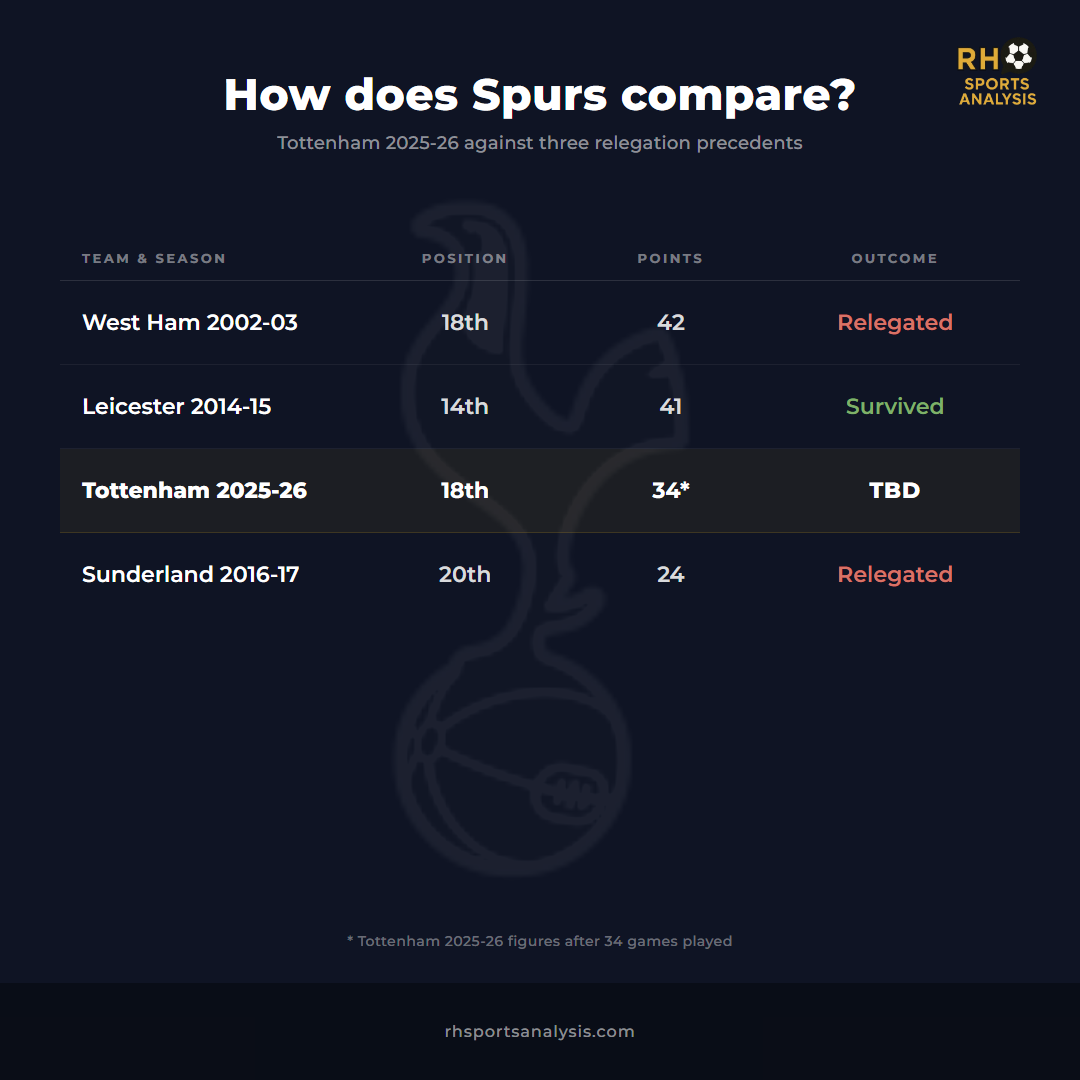
The Spurs side currently sitting eighteenth on thirty-four points after thirty-four matches has more in common with the West Ham version of the story than the Leicester version. The squad cost too much to be in this position, the defensive numbers are above the relegation pace, and with Burnley and Wolves already mathematically down, Tottenham occupy the third relegation spot, two points behind West Ham in seventeenth, with four matches left. Sunderland 2016-17 went down with twenty-four points after a managerial carousel and the worst home record in their league history, but Sunderland were never truly in the conversation for survival from January onwards. Tottenham still are.
Whether Spurs survive will turn on four fixtures and on whether the squad De Zerbi has been handed produces enough goals to climb back above the relegation line. If they do, the season becomes a story of structural failure narrowly averted. If they do not, they become the most expensive side ever to be relegated from the Premier League, and West Ham 2002-03 stops being the closest comparison and becomes the reference point everyone reaches for next.
The seventh decision
The first six decisions of this story all had an answer. Tottenham's owners decided a Europa trophy was not enough, Frank was the answer to the league position, Tudor was the answer to the dressing room, and De Zerbi was the answer to Tudor. Each one was a call the club knew how to make, with precedents to lean on and a structure built around the assumption that Premier League football would anchor everything else.
The seventh decision is the one no one at the club has been asked to make yet.
Four matches will tell whether they have to.
Related reading
How West Ham Got Here: Bowen Saw It Coming
Tottenham vs Brighton Preview: De Zerbi's Homecoming With Spurs in Relegation Trouble
Our members receive data-driven selections across every sport we cover. Are you in?