




Why Antonelli Keeps On Winning
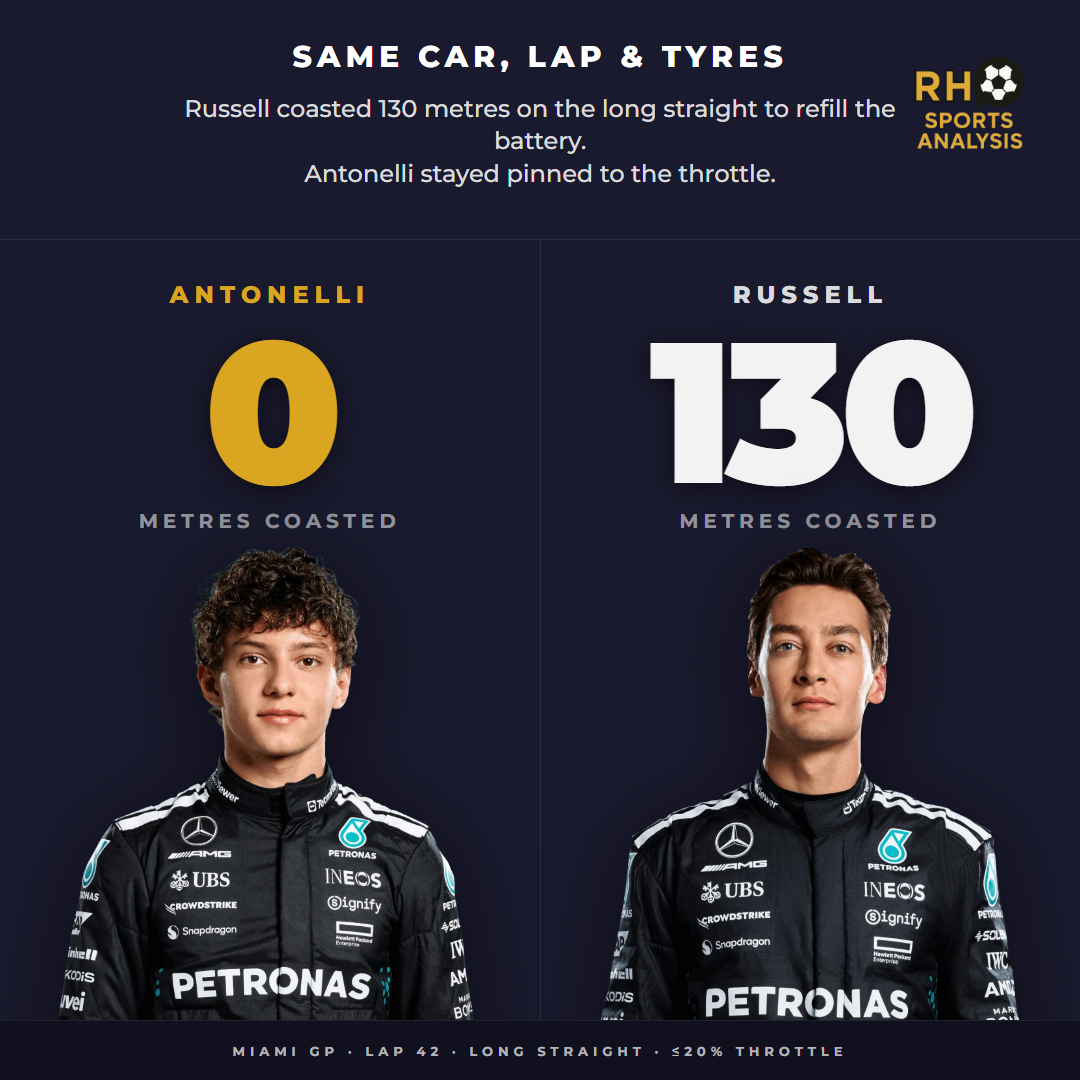
On lap 42 of the Miami Grand Prix, both Mercedes drivers approached the same long straight, on the same tyre, with identical engine, fuel, battery and regulations. One of them coasted for 130m before braking. The other did not lift his right foot once. The driver who coasted was George Russell, a six-time Grand Prix winner. The driver who did not lift was his teammate, the nineteen-year-old Kimi Antonelli, who went on to win the race.
That single comparison is the cleanest answer Formula 1's data has to offer to a question that has dominated paddock conversations since China. Antonelli keeps winning races because Mercedes is in the fastest car on the grid, and because his teammate is paying an energy tax bill that he is not.
The energy tax everyone is paying
To understand why a 130m coast matters, the 2026 power unit regulations have to land first. Formula 1 has shifted the engine balance to roughly fifty-fifty between combustion and electrical, with the MGU-K nearly trebling in output, from 120kW to 350kW. The battery itself is capped at 4MJ of usable energy, which the cars can deplete several times across a lap, but only if they recharge it back up in between. Drivers do that by harvesting energy under braking, or by lifting the throttle on the straights and letting the car coast while the battery refills.
On most circuits the cumulative energy budget is set at 8.5MJ per lap, which is not enough to power the car flat out from start to finish. Lift-and-coast is no longer a tool drivers reach for at the end of long stints. It is part of every fast lap, in qualifying and in the race.
Max Verstappen calls the new cars “Formula E on steroids.” Lando Norris says Formula 1 has gone from “the best cars ever made” to “probably the worst.” Lewis Hamilton, at the Bahrain test in February, complained about “doing 600 metres of lift-and-coast on a qualifying lap.”
“Sometimes you push more, you lose the battery and you just go slower.”
— Lando Norris
Charles Leclerc, in the Shanghai paddock, summarised what the racing had become. The opening laps of races, he said, had developed “quite a big yo-yo effect,” with cars accelerating past one another on a battery boost, then giving the position back when the boost ran out, then taking it back again.
Then on lap 42 of Miami, Antonelli stayed pinned to the throttle while his teammate gave 130m back.
Same car, same race, the gap is widening
A single comparison would be a curiosity if it were one lap of one race. It is not. Forty-eight hours earlier, on the run for pole position in Miami qualifying, Russell coasted four times as much as Antonelli on his fastest Q3 lap, with both Mercedes drivers on fresh soft tyres in near-identical conditions. The qualifying gap between them was 0.399 seconds in Antonelli's favour.
0
Q3 gap, in Antonelli's favour, in the same Mercedes
Through the opening four races, Antonelli's race pace went from broadly matching Russell's to nearly a second per lap clear of him. The gap was within measurement noise in Australia and China. By Suzuka it had opened to 0.61 seconds per lap. By Miami, 0.88. Russell finished 43 seconds behind his teammate at the chequered flag, in fourth, beaten by both McLarens. A six-time Grand Prix winner being beaten by nine tenths of a second per lap by the second car in his own team, on a race weekend where the team won, is the sort of intra-team gap that does not happen by accident.
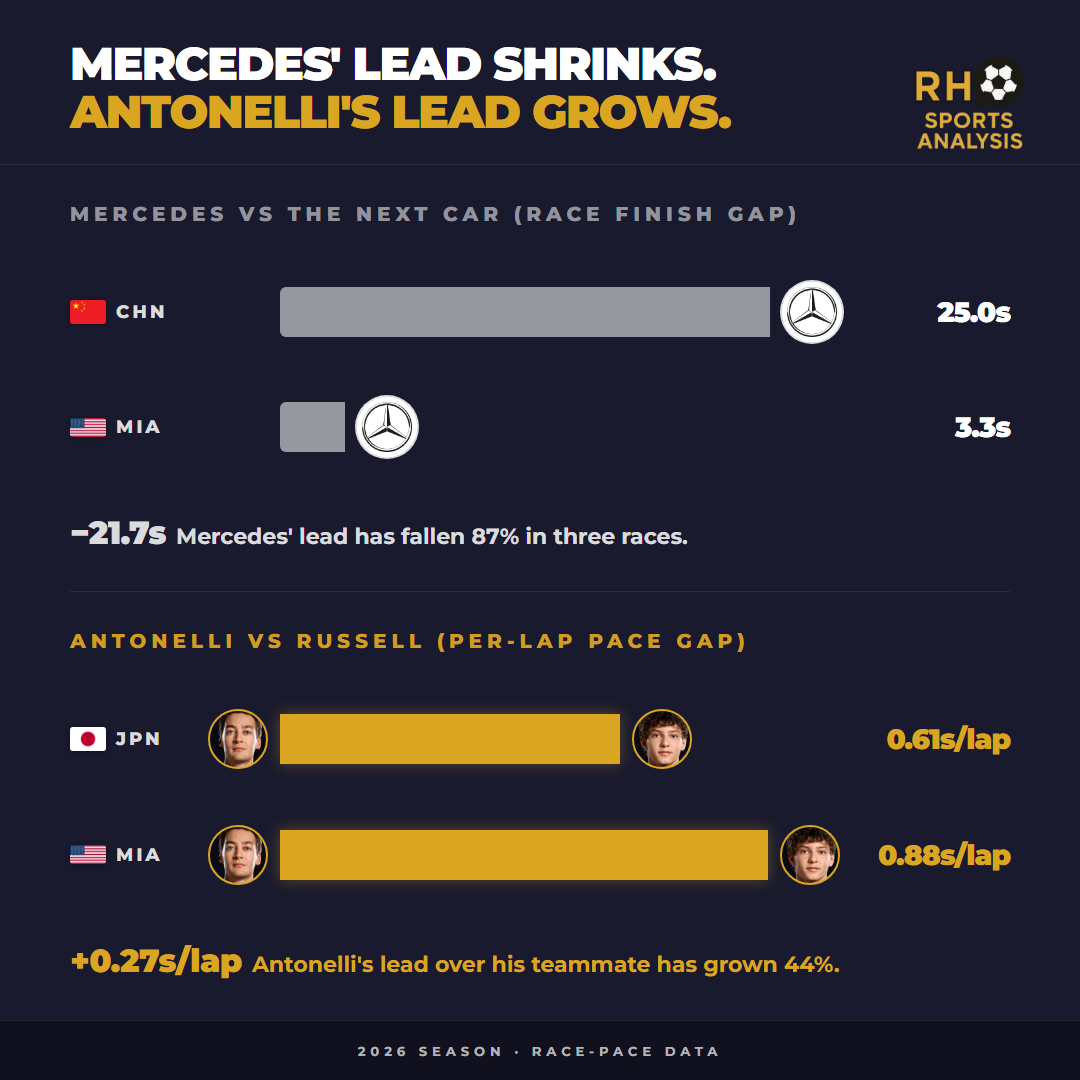
The gap to the rest of the grid is moving the other way. Mercedes finished one-two in Australia and China, with the first non-Mercedes car 25 seconds back at Shanghai. By Miami that margin had shrunk to 3.3 seconds, with Norris's McLaren on the leader's tail at the chequered flag. The car edge that won Mercedes the opening rounds of the season is closing. The driver edge inside the team is widening.
Where Antonelli sits in the field
Antonelli is not the only driver in Formula 1 who has worked out how to drive the 2026 car flat out. The Miami qualifying picture, with the seven cars within 0.55 seconds of pole, sorts into three groups. Two drivers, Verstappen and Leclerc, completed their fastest Q3 laps without coasting at all by the strict measure of throttle below 20%. A second tier sits just behind them: Antonelli and Piastri, both coasting around 17m on their fastest laps. Then the rest, with Hamilton, Norris and Russell coasting progressively more.
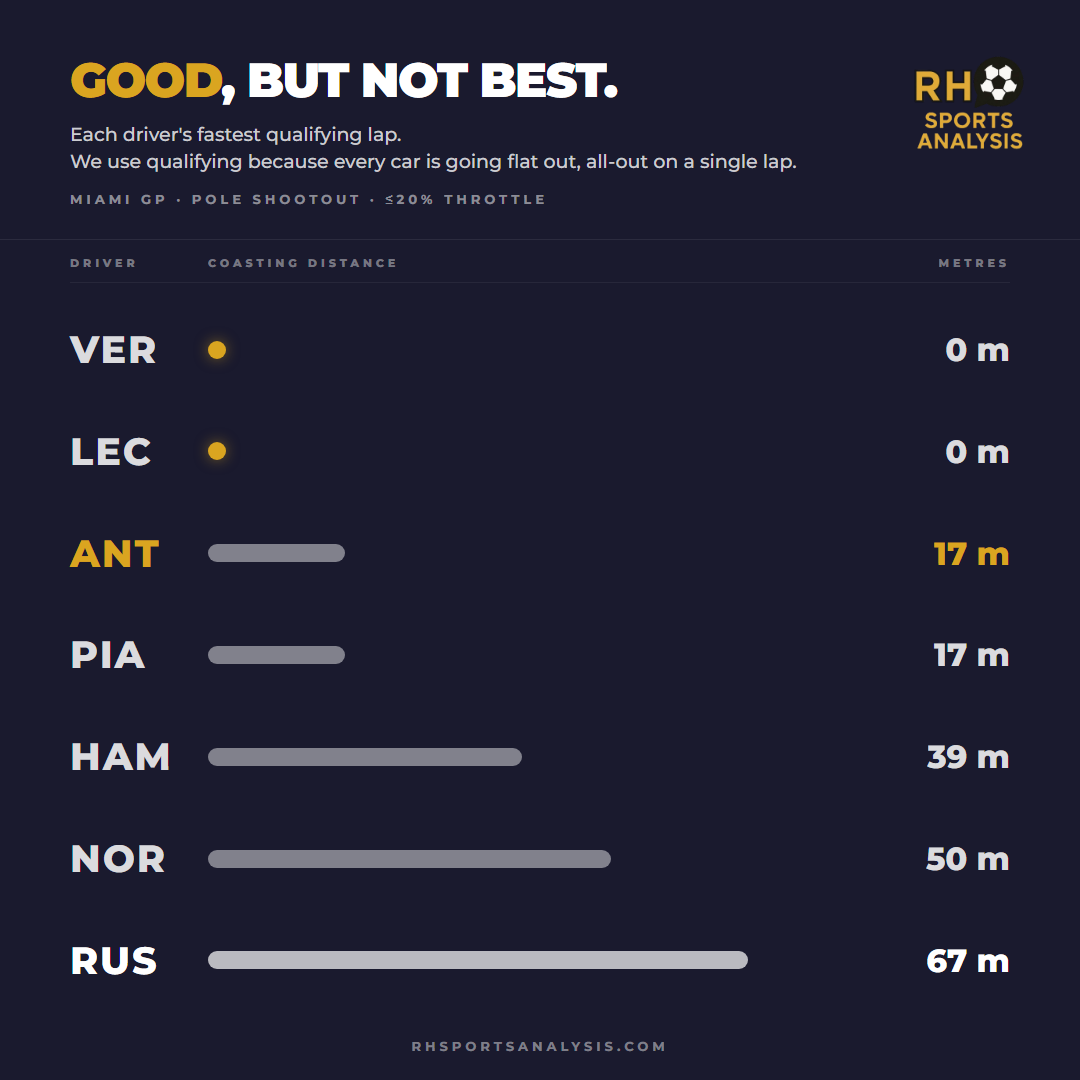
So Antonelli is good at this, not best. Verstappen and Leclerc are cleaner. The detail that decides the wins, however, is what happens lower down that ranking, because Antonelli's teammate sits at the bottom of the seven. Russell, in the same car, on the same tyre, with the same regulations to negotiate, coasted four times as much as Antonelli to put together a Q3 lap that finished four tenths of a second slower. That gap, in the same machinery, is the entire story.
0
Russell's Q3 coasting distance versus Antonelli's, in the same Mercedes on the same tyre
The two drivers ahead of Antonelli on lift discipline are not in the fastest car. Leclerc is in a Ferrari that has been Mercedes's nearest challenger but not its equal across the four rounds. He has, according to Mark Hughes, “drawn up a team of his own software experts to help him understand how best to optimise the systems in every situation.” Verstappen, the four-time world champion who has spent the season publicly comparing the regulations to Mario Kart, finished fifth in Miami in a Red Bull that has not won a race in 2026. Antonelli sits in the only seat on the grid where lift discipline of this calibre meets a car capable of converting it into wins.
How the tax bill stays small
How Antonelli avoids the lift is the mechanical question, and the data has a clear answer. Across Miami qualifying, Russell's top speed at the end of the main straight was 344 km/h. Antonelli's was 343. Through the lap as a whole, however, Antonelli's average speed was 5.95 km/h higher. The difference is not in the engine, the aerodynamics, or any deployment trick the team applied to one car and not the other. It is in the corners.
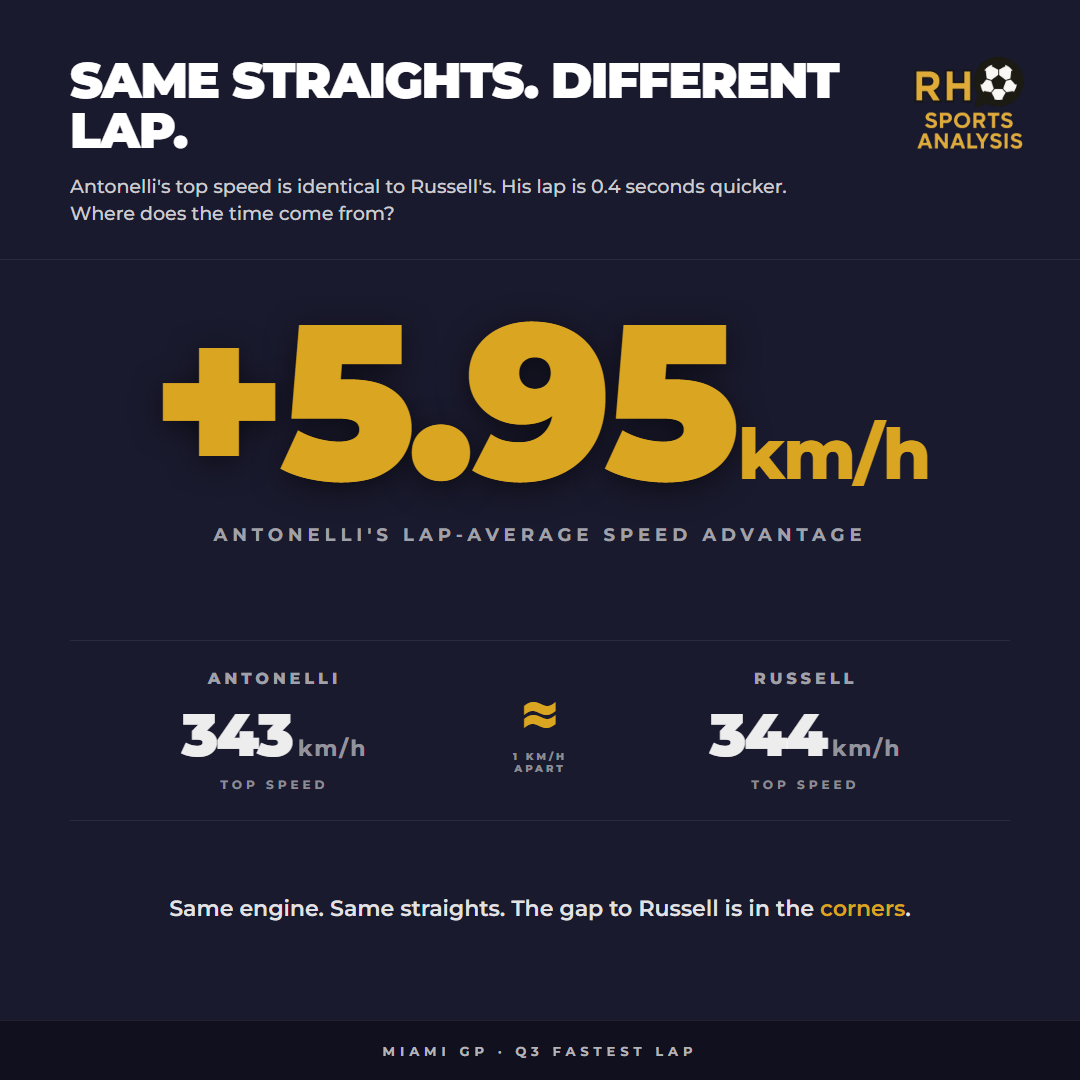
Antonelli carries 3 to 7 km/h more apex speed than Russell in three specific corners per lap, with the rest within 1 or 2 km/h either way. He spends about 2 percentage points less of the lap with the brake pedal applied, and 1 to 3 percentage points more of the lap at full throttle. The effect is cumulative. More speed through the apex means harder, shorter braking on the way in, which means more energy harvested by the rear axle. More energy harvested means more battery available for the next straight, which means less need to lift to refill it on the way to the corner after that. The faster the car is through the corners, the more it pays its own energy bill.
Karun Chandhok, writing on Antonelli's Suzuka qualifying lap, described it as “excellent at just slightly delaying the final step of his throttle application out of a couple of key corners.” The result, Chandhok noted, was that Antonelli accelerated marginally slower at first, but more than made up for it by delaying the ramp-down of the electric power level at the end of the straight. Antonelli's race engineer, Peter Bonnington, sees the same thing in the data, framed differently. “There are the balance traces that we look at,” Bonnington said in March.
“I don't know how he's driving the car so neutrally, yet keeping it all together and keeping the temperatures under control, yet the thing is ready to pivot on its own axis.”
— Peter Bonnington
The question the data can't answer
How Antonelli arrived at this style is the question the data cannot answer. He has been a Mercedes Junior since he was 12 years old. Mercedes installed an F1 simulator and an F1 steering wheel at his home in late 2024 so he could memorise the buttons by feel before his rookie season. By his own admission in pre-season testing, his Bahrain preparation focused “mainly on getting the deployment right” for Australia, with “a lot of sim work, just to get it right.”
Whether that work is what built the style, or whether the style was already there and the regulations finally rewarded it, is a question the data cannot resolve. What the data can resolve is that on lap 42 of Miami, the nineteen-year-old in the second Mercedes was driving the car as if the regulations were not there. The two drivers in the field who matched his discipline on a flying qualifying lap, Verstappen and Leclerc, are not in the fastest car. His teammate, who is, is paying the energy tax that Antonelli is not.
The pattern is not yet universal. At Suzuka, on his fastest Hard race lap, Antonelli lifted more than Russell did, and still won the race. But across the four rounds the trajectory is moving in only one direction. He keeps winning because the car is fast, and on the laps that decide the outcome, the tax bill is somebody else's problem.
Related reading
Our members receive data-driven selections across every sport we cover. Are you in?