




Casemiro: Reborn, and Leaving
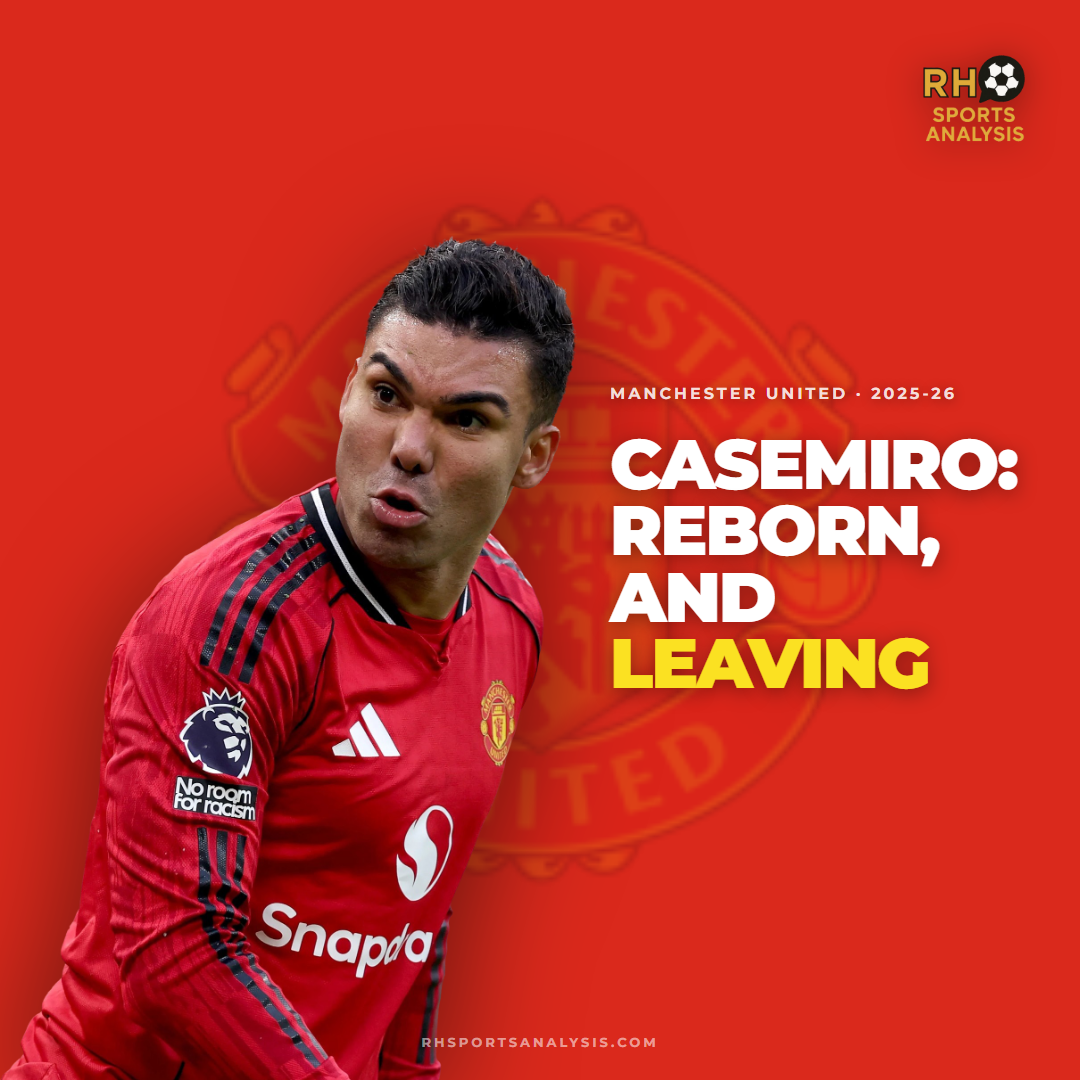
Casemiro glanced Bruno Fernandes's near-post corner across Emiliano Martínez and inside the right-hand post. The Stretford End broke into a chant nobody had used at Old Trafford in years, one more year, one more year, Casemiro, and he pointed to the badge.
With 15 weeks left on his contract, the 53rd minute against Aston Villa on Sunday the 15th of March 2026 was supposed to be one of the last starring acts in red of a 34-year-old midfielder running on fumes in a season already accounted for. Instead it was the eighth headed goal of his Premier League season, and the latest piece of evidence that the player Manchester United are letting walk away in the summer is the player they cannot win without.
The football has left him
22 months earlier the same player was being told to retire on television. The 6th of May 2024 was the night the consensus crystallised: Crystal Palace thumped Manchester United 4-0 at Selhurst Park, with Casemiro deployed as a makeshift centre-back alongside Jonny Evans, and the goals carried his fingerprints in big bold letters. Michael Olise jinked past him for the opener inside 12 minutes, and by the fourth, Daniel Muñoz had picked his pocket on the byline near United's own corner flag.
Selhurst Park was chanting “sacked in the morning” at Erik ten Hag, and Jamie Carragher delivered the verdict that would follow Casemiro for the next two years: he should know himself that he had three games left at this level, then an MLS or Saudi exit.
The football had left him.
— Jamie Carragher, 6th May 2024
Four months later, on the 1st of September 2024 against Liverpool at Old Trafford, the verdict looked confirmed. Casemiro lost the ball in build-up for Luis Díaz's first goal, was dispossessed for the second, and was hooked at half-time with United two down. Toby Collyer, 20 years old, made his Premier League debut in his place. Roy Keane, on co-commentary, was talking about how finished he looked, and that was the consensus on Casemiro in the autumn of 2024.
One start in 14 games
By December 2024 the new manager had taken over and the consensus was being institutionalised inside the building. Erik ten Hag had been sacked at the end of October, Ruud van Nistelrooy had taken interim charge for four games and started Casemiro in all of them, and on the 11th of November Rúben Amorim arrived from Sporting.
What followed was the worst spell of Casemiro's senior career: between mid-December and early February, Manchester United played 14 matches and Casemiro started one of them, the 2-0 home defeat to Newcastle on the 30th of December. He was an unused substitute for nine of the others, and played 136 minutes from a possible 1,260.
Towards the end of January, Amorim spelled out the reasoning publicly: Casemiro had other qualities, the manager said, intelligence, an understanding of the game, an ability to read where the ball was going to fall. But this was a league with a different intensity, and he felt the team needed players who could match it. Sometimes, he said, they did not have them.
The destinations linked to him in the Spanish and Italian press that month were Roma on loan, the MLS, and the Saudi Pro League. Casemiro said in February he wanted to finish his contract at Old Trafford. The contract had 18 months to run.
Three defenders and the wing-backs pressing high
What turned the season was an injury to somebody else. Manuel Ugarte, Casemiro's competitor for the deep midfield slot, was unavailable for the Real Sociedad home leg on the 13th of March 2025, and Amorim had no choice but to start the older option. United won 4-1, Casemiro hit a passing range that drew comparisons with his Real Madrid days, and Amorim said publicly afterwards he was learning how to use him.
By the start of May, Manchester United ran out 3-0 winners over Athletic Club at San Mamés in the first leg of the Europa League semi-final, and Casemiro was the standout performer in red. He headed in the opening goal on 30 minutes from a Harry Maguire cross flicked on by Manuel Ugarte at the near post, won every aerial duel he contested, broke up the press, and ran a midfield Maguire later described, in two words, as everywhere.
In a press conference the following week, Amorim made the climb-down he had not made publicly before. “Then we understood that he cannot jump all the time pressing high. Sometimes it's better to put three defenders and let him be the fourth defender and put the wing-backs pressing high. The credit is for Casemiro.”
The role moved, not the legs
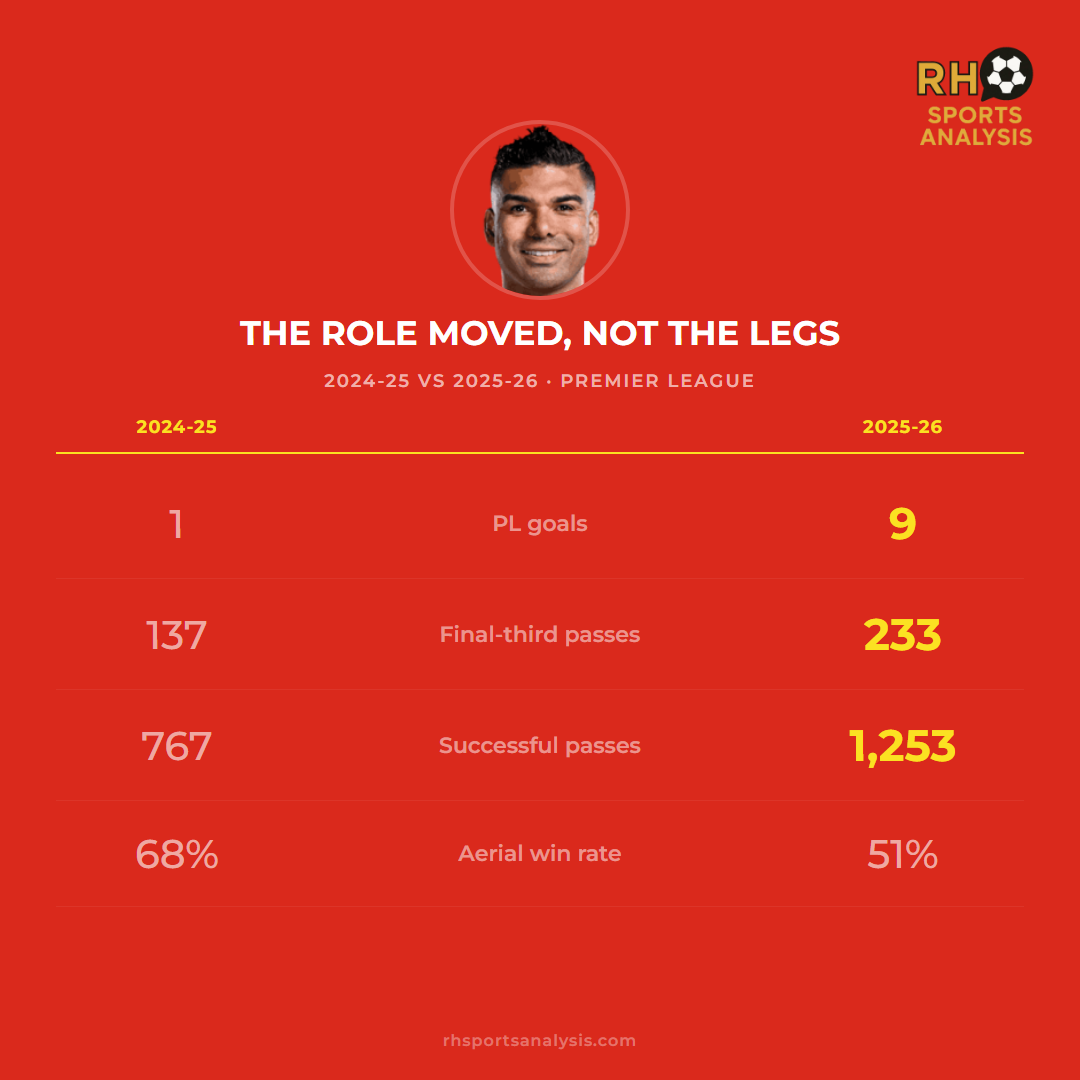
By the end of April 2026, Casemiro had scored 9 Premier League goals in his fourth and final United season, more than the four he scored in 2022-23, the one in 2023-24, and the one in 2024-25 combined. He had started 32 league matches, played 2,508 minutes, and completed 1,253 successful passes against the 767 he managed last year. His 233 passes into the final third dwarfed the 137 he hit there 12 months earlier.
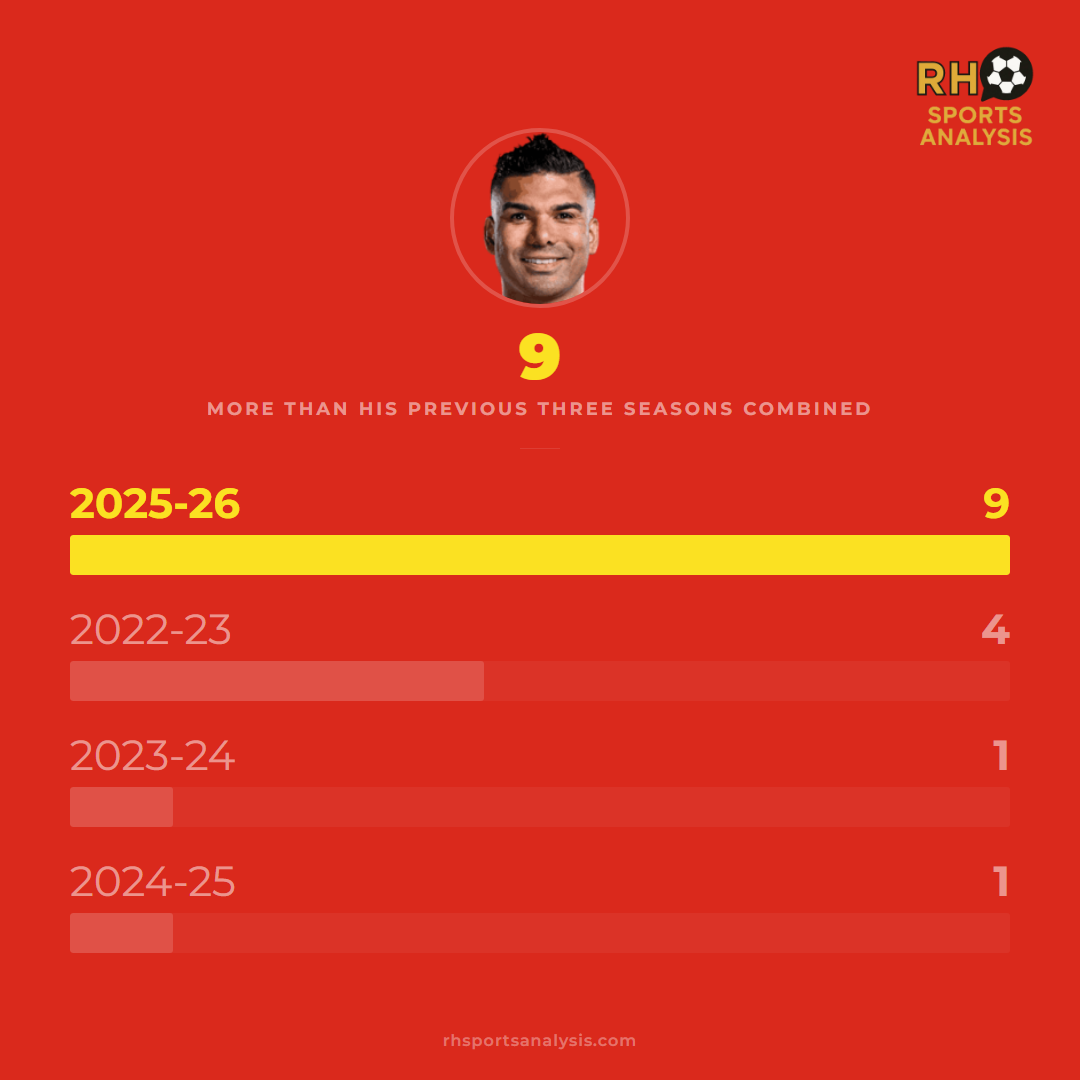
That is what the recovery looks like in the headline numbers, and it is also where the simple version of this story falls apart. The simple version is that Real Madrid Casemiro is back from the dead, the destroyer who held Toni Kroos and Luka Modrić's midfield together through four Champions League wins, returned on full beam at 34.
The data does not support that: Casemiro's tackle success rate is 50 per cent, the lowest of his United career. His aerial win rate is 51.4 per cent, down from 68.4 per cent last year, and his tackles and duels per 90 are both lower than they were a season ago. The defensive volume he was once defined by has dropped, not climbed.
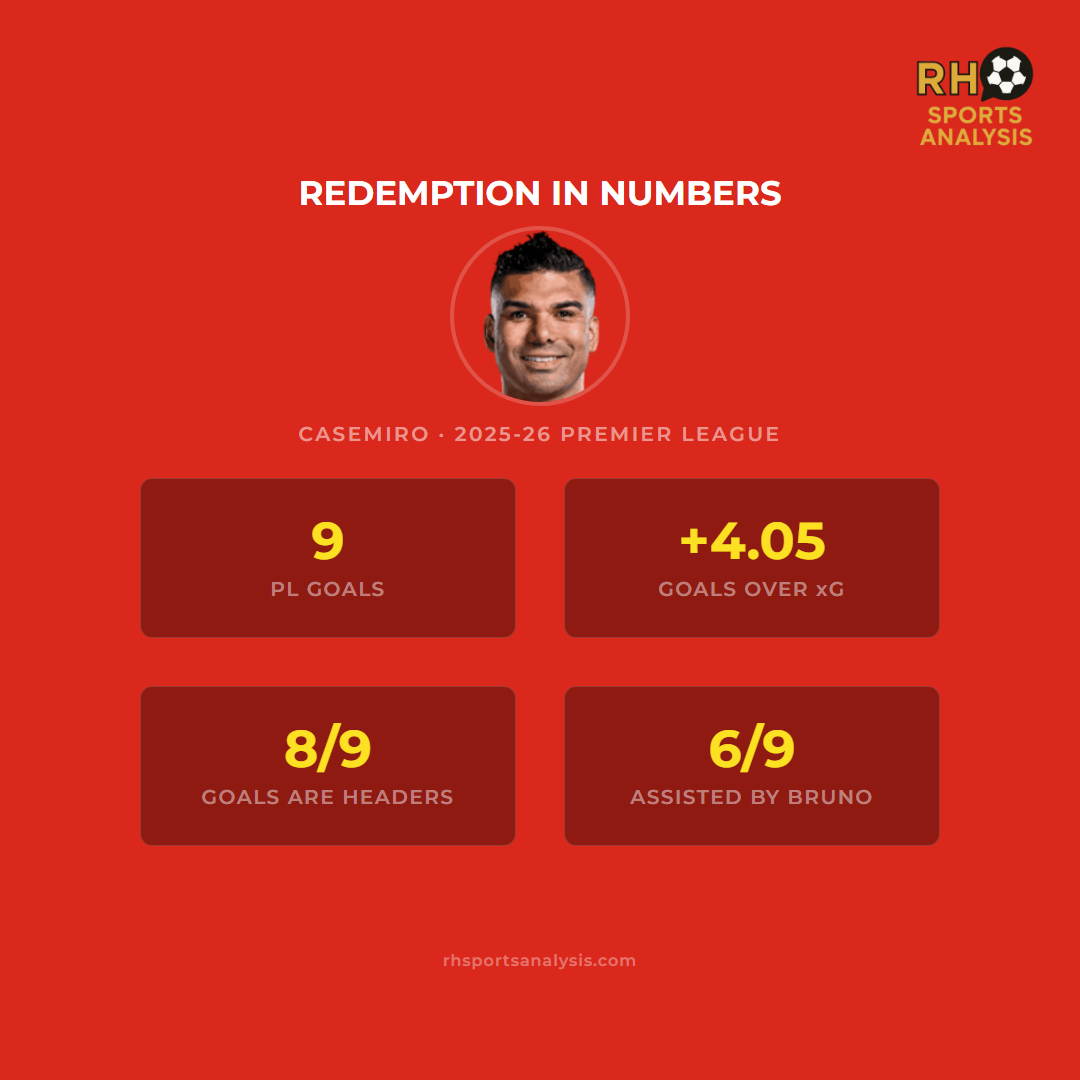
What changed is the role: Amorim built a system where Casemiro drops in as a fourth defender while the wing-backs press high, freeing him to contribute further up the pitch in build-up and inside the opposition box. Eight of his nine Premier League goals are headers, six of them assisted by Bruno Fernandes, and the nine have come from an expected goals figure under five. He has not recreated himself, he has found the one finishing edge a 34-year-old defensive midfielder could realistically have hoped to find.
Three matches without him, three defeats
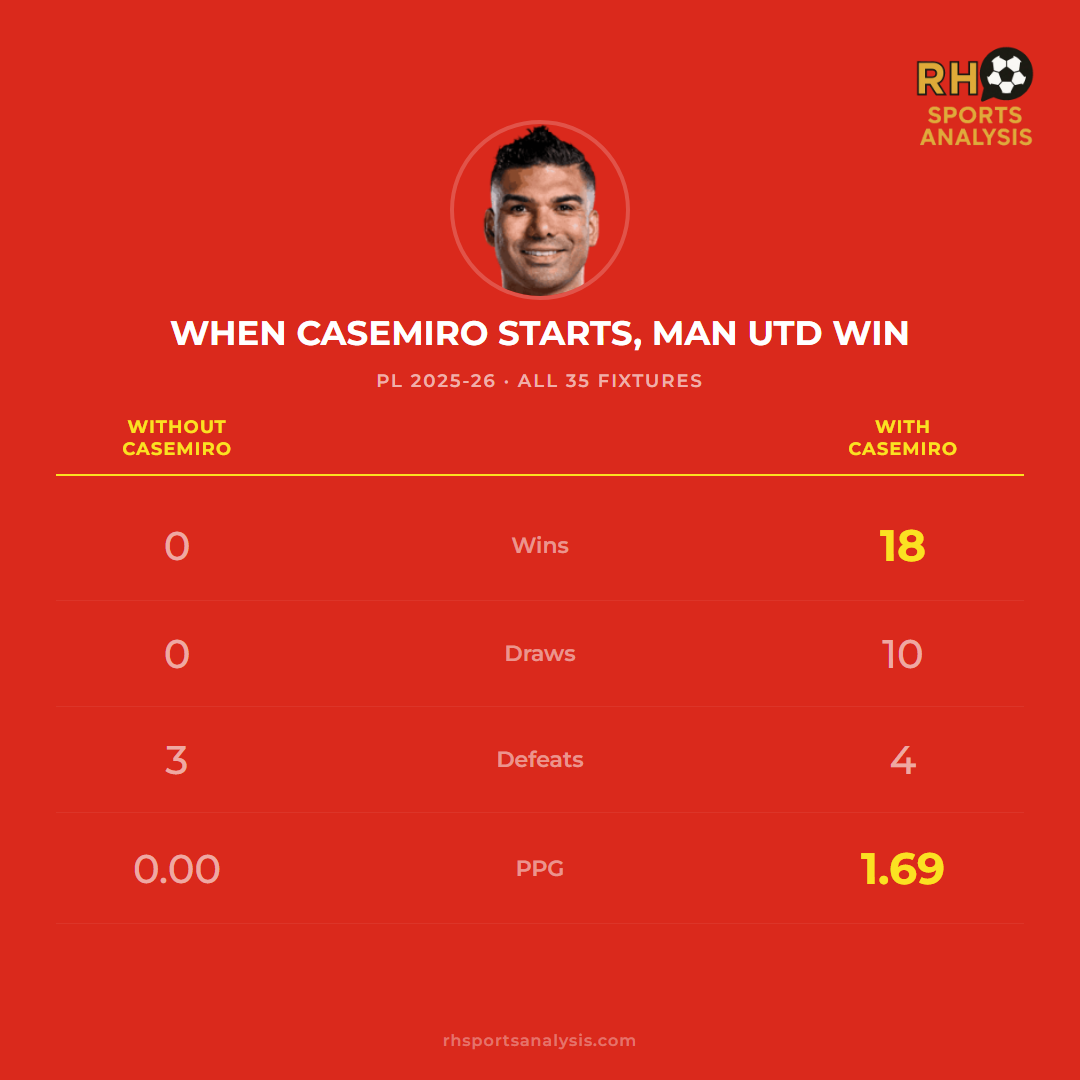
The case for Casemiro as the player United cannot win without is built on three matches he did not start.
The three he did not start
Premier League 2025-26



At the Etihad, Manuel Ugarte started in the deep midfield slot, Phil Foden headed City in front on 18 minutes, and Casemiro came off the bench for the final 10 minutes with the score already settled. At Brentford, Igor Thiago scored twice inside 20 minutes against a midfield pivot of Bruno Fernandes and Manuel Ugarte that was outnumbered and overrun.
Three matches, three defeats, zero points. In the other 32 matches Casemiro started in the league, United took 58, going 18 wins, 10 draws, and four defeats. The points-per-game gap is 1.69 with him on the pitch and zero without.
Those are the entire team's points return, and they break clean along the line of one player's availability. When Casemiro plays, United can grind out the kind of compact, set-piece-driven nights they have built their season on. When he does not, the middle is overrun and everyone else is exposed.
The wage bill made the call
On the 22nd of January 2026, Manchester United announced that Casemiro would leave at the end of the season, on the expiry of his contract. The reasoning was financial. Casemiro is on £350,000 a week and £18.2 million a year, the highest-paid player in the squad and a contract that, 10 months earlier, Sir Jim Ratcliffe had publicly grouped with the inherited signings he called either not good enough or overpaid. Project 90, INEOS's wage-bill reduction programme, had already cut United's wage bill from £364.7 million to £313 million across two seasons, with a target of pushing it lower still. The departures of David De Gea, Raphaël Varane and Marcus Rashford had laid the groundwork. Casemiro and Jadon Sancho's contracts running down were the next moves.
The official wording was that Casemiro would leave “upon the expiry of his contract.” United had not triggered the one-year option in his deal, and they had left the door open for him to stay if he agreed to a significant pay cut. He did not take it, and the club did not extend an alternative.
The same day the news broke, Casemiro recorded a video for the club channels that ran two paragraphs longer than the announcement. “I will carry Manchester United with me throughout my entire life. From the first day I walked out at this beautiful stadium, I felt the passion of Old Trafford and the love that I now share with our supporters for this special club. It is not time to say goodbye, there are many more memories to create during the next four months.”
One more year, Casemiro
Eight weeks after the announcement, the supporters delivered their answer. When Casemiro headed in against Aston Villa on the 15th of March, the Stretford End started a chant of “one more year, one more year, Casemiro” that ran from the celebration through the rest of the half and was repeated as he walked towards the tunnel at full-time. The same chant returned on the 27th of April, after his 11th-minute header from Maguire's nod-back across goal against Brentford. By that point Manchester United were on their third manager of the season, Rúben Amorim having been sacked on the 5th of January and Michael Carrick installed eight days later, and yet the song was the same one.
Matheus Cunha, watching the Brentford game from his seat at Old Trafford with a hip-flexor injury, posted on Instagram while it played out. The caption read: “One more year, Casemiro.” Bruno Fernandes and Leny Yoro had both said publicly that month they wanted Casemiro to stay. In the matchday programme Q&A that ran the same week, Casemiro mentioned that his wife had cried the first time she heard the chant.
The manager wanted him, the captain wanted him, the dressing room wanted him, the supporters wanted him. The football board did not.
The football has not left him
21 months after telling Casemiro to retire, Jamie Carragher took it back live on television. It was the 1st of February 2026, after Manchester United had edged Fulham 3-2 at Old Trafford with Casemiro scoring and assisting on a man-of-the-match performance.
“It is now fair to say the football has not left him.”
— Jamie Carragher, 1st February 2026
He went on: “Considering what he's producing this season in the Premier League, and not just Fulham at home, you think what he did last week against Arsenal away and Manchester City at home.”
Casemiro looked completely different physically: when the verdict was first delivered in May 2024, Casemiro looked, as Carragher put it, like an old man coming to the end of his time as a player. By February 2026 he looked leaner, fitter, freer. Carragher could not explain it, but he knew the player on the pitch was not the same one he had written off.
Leaving on his own terms
Casemiro will be 34 when he plays his last competitive match for Manchester United, at the Amex Stadium on the 24th of May 2026. He will have started the most Premier League games of any United season he has spent at the club, scored more goals in the league than across the previous three seasons combined, and walked off the pitch with a chant the building reserves for players the supporters refuse to let go of.
His career résumé sits a layer deeper than the United chapter. Five Champions League titles at Real Madrid, in 2014, 2016, 2017, 2018 and 2022, won as the destroyer at the base of one of the greatest midfields European football has produced. The 2023 Carabao Cup final at Wembley, where his 33rd-minute header ended a six-year United trophy drought. A Brazil recall under Carlo Ancelotti, and a third senior World Cup squad place ahead of him this June.
The footballer arriving in North America with Brazil this summer is not the Casemiro who held Toni Kroos and Luka Modrić's midfield together. The role has moved, the legs have aged, and the data is honest about both. What he is, in the spring of 2026, is the rare elite footballer leaving a top club on his own terms while still good enough that it is the supporters who are not ready. United are letting him walk because £18 million a year is the wrong shape for the rebuild. Casemiro is walking out as the player they cannot win without. The summer will sort the rest.
Related reading

Harry Maguire Says He's One of the Best in the World. We Checked.
Manchester United vs Liverpool Preview: Carrick's Audition, Liverpool's Third-Choice Keeper & Bruno's Record Chase
Our members receive data-driven selections across every sport we cover. Are you in?