




Built to Score: The System That Made Mohamed Salah
In 33 Premier League games where Trent Alexander-Arnold and Mohamed Salah both started during the 2024-25 season, Salah scored 27 goals. In the five league games Trent missed that season, Salah scored twice, both in the same match against Southampton. That is not a coincidence, not a sample size quirk, not a confidence issue. It is the clearest statistical fingerprint of what Mohamed Salah actually was at Liverpool: one of the most devastating wingers in English football, operating inside a system specifically engineered to feed him.
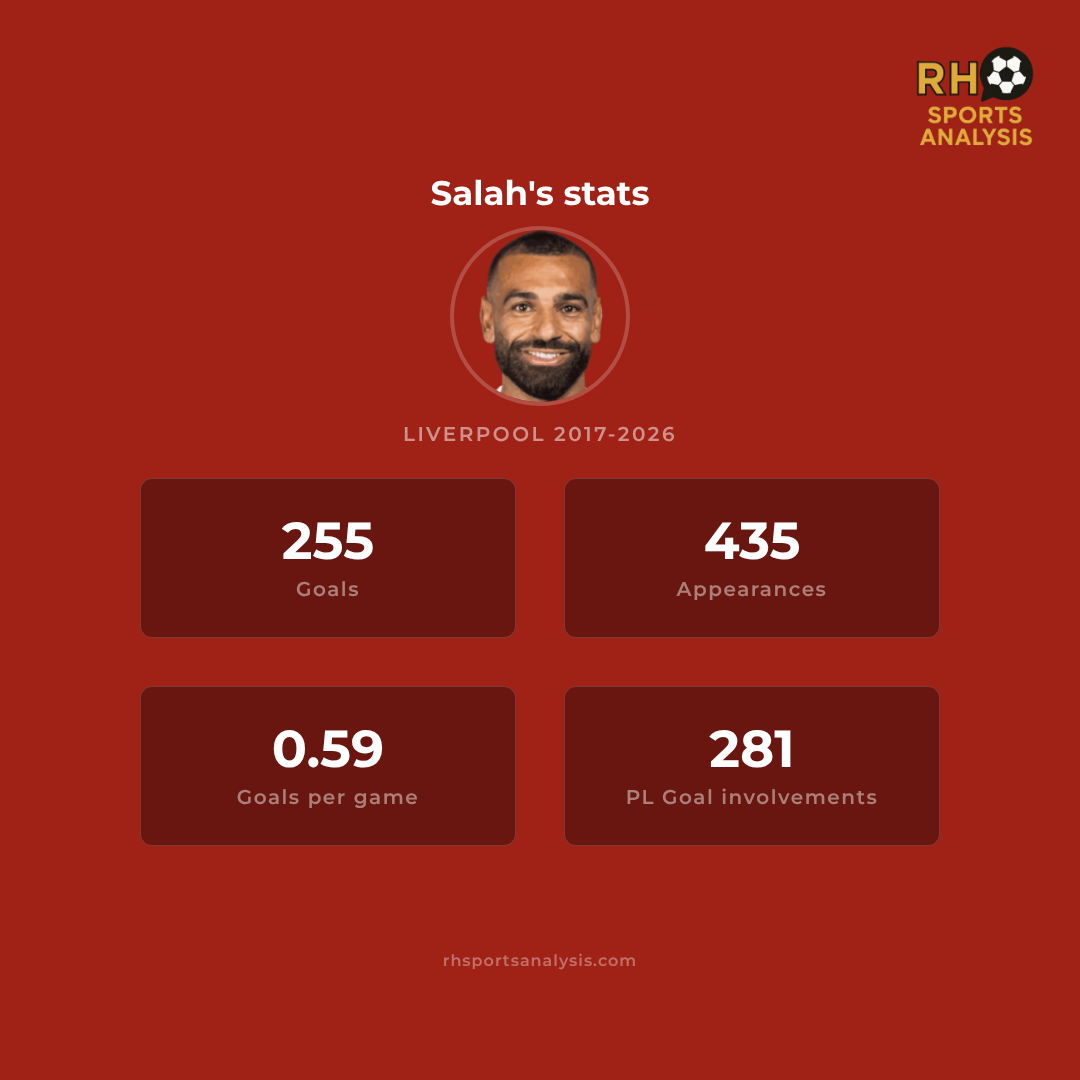
Salah confirmed his departure from Liverpool on 24th March 2026, ending a nine-year stay that produced 255 goals in 435 appearances, three PFA Players' Player of the Year awards, four Golden Boots, and a place as the third-highest scorer in the club's 134-year history. The farewell tributes have focused on the individual brilliance, the records, the moments that defined an era. The numbers tell a more nuanced story, one about a player whose genius was inseparable from the machine around him, and a machine that no longer exists.
147 passes that changed everything
The relationship between Trent and Salah was not just productive, it was historically anomalous. During that record-breaking 2024-25 campaign, Trent played 147 line-breaking passes to Salah, at least 39 more than any other passing combination in the entire Premier League. Of those, 37 broke the opposition's last defensive line. The next highest combination in the league managed 29.
0
Line-breaking passes from Trent to Salah in 2024-25, at least 39 more than any other Premier League combination.
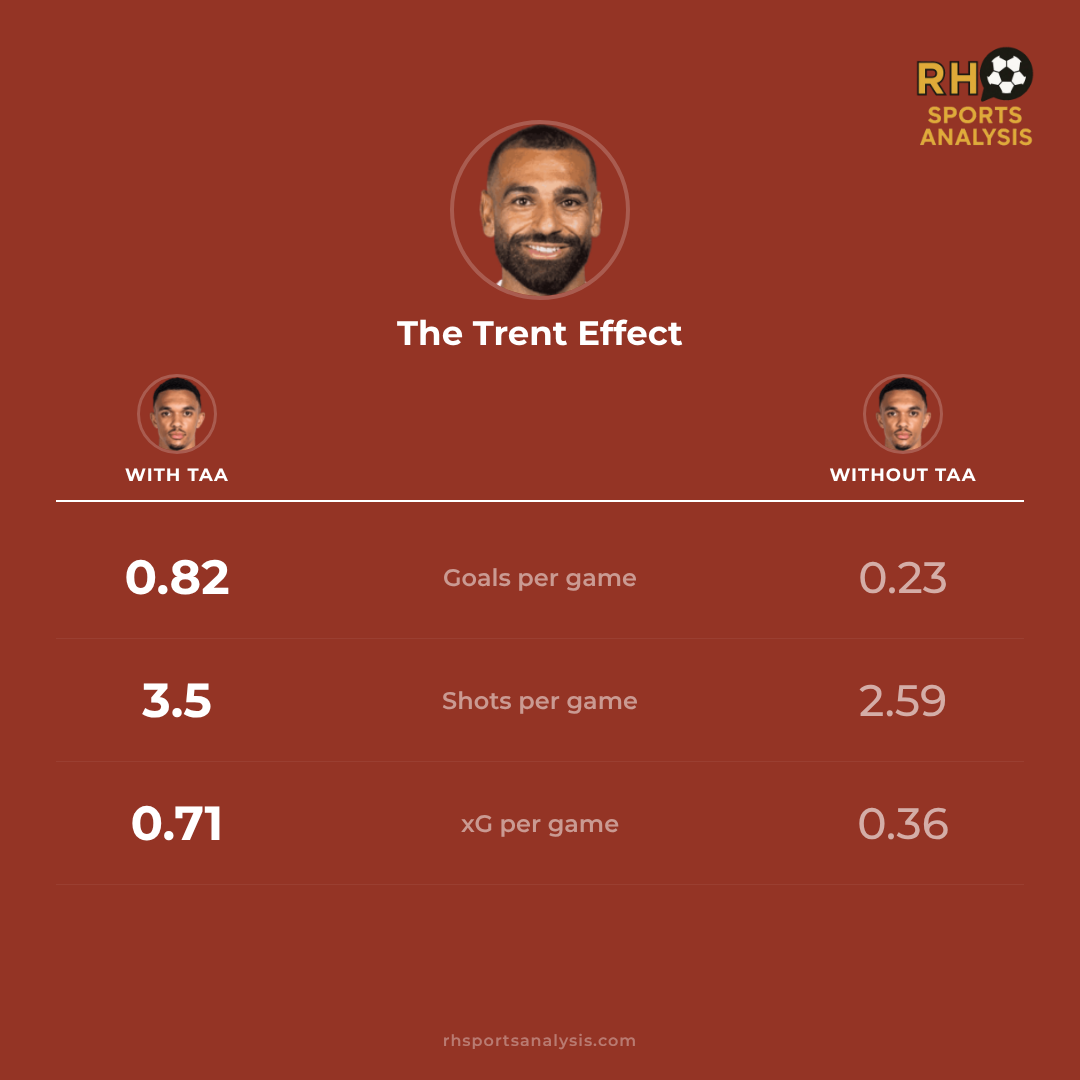
Those passes were the foundation of everything. When both were on the pitch in 2024-25, Salah averaged 3.5 shots per game, touched the ball in the opposition box 10.5 times per 90 minutes, and scored at a rate of 0.82 goals per game. In 2025-26, with Trent gone to Real Madrid, those numbers collapsed: 2.59 shots per game, 0.23 goals per game, and an expected goals rate that halved from 0.71 to 0.36 per game. Same player, same position, fundamentally different output.
Trent's departure to Real Madrid in the summer of 2025, with Liverpool accepting a reported £8.4 million early-release fee to let him leave a month before his contract expired. This move did not just remove Liverpool's best right-back but it severed arguably the most productive creative partnership in Premier League in history. This was a pipeline that Salah's game had become entirely dependent on it.
Built to score: how Klopp's system created a monster
Salah arrived from Roma in 2017 as a quick, direct winger with a habit of cutting inside from the right. He left nine years later as the highest-scoring non-English player in Premier League history. The transformation was not simply a matter of individual improvement, it was architectural.
Jürgen Klopp's Liverpool was built around a specific set of spatial relationships. Roberto Firmino dropped deep from the centre-forward position, dragging centre-backs with him and creating pockets of space behind the defensive line. Sadio Mané, operating on the left, stretched the pitch horizontally and occupied the opposite full-back. Robertson and Trent pushed high and wide, becoming the primary width providers, which freed both wingers to occupy the half-spaces and penalty area. Salah's role was not to hug the touchline. It was to start wide, drift inward, and arrive in the positions where goals are scored.
The numbers from those early Klopp seasons were staggering. Thirty-two league goals in 2017-18, the most in a 38-game Premier League season at the time, delivered at a rate of 2.5 completed take-ons per 90 minutes. He was a winger who scored like a striker, and the system around him was the reason. Firmino's movement created the space, Mané's presence occupied the coverage, and Trent's delivery found him in it.
What separated Salah from other prolific wide forwards was his ability to evolve as the system evolved. When Mané left for Bayern Munich in 2022, Salah adapted. When Firmino departed a year later, Salah adapted again, drifting wider, creating more, adding an assist dimension that transformed him from goalscorer to complete forward. His Premier League assist tallies tell the story.
Salah's Premier League Assists by Season
| Season | 17-18 | 18-19 | 19-20 | 20-21 | 21-22 | 22-23 | 23-24 | 24-25 |
|---|---|---|---|---|---|---|---|---|
| Assists | 10 | 8 | 10 | 5 | 13 | 12 | 10 | 18 |
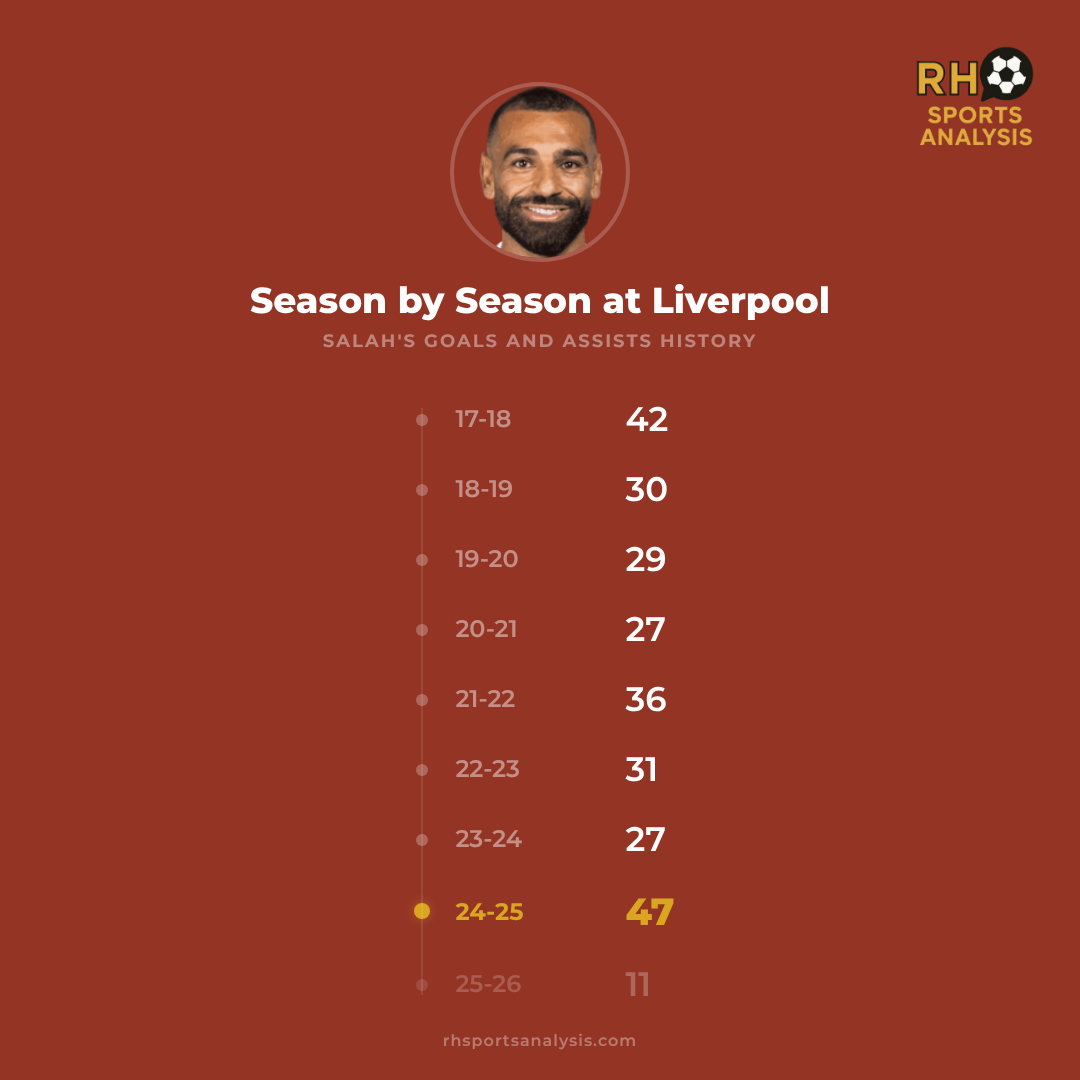
That final figure, 18 in 2024-25, gave him the most goal involvements in a single 38-game Premier League season in the competition's history: 47, surpassing Thierry Henry's 44 from 2002-03.
By that point, Klopp had been replaced by Arne Slot, but the one constant in the system, the Salah-Trent axis, remained intact. And so did the goals.
The last perfect season
The 2024-25 campaign was Salah's masterpiece, and it only makes sense when viewed through the lens of everything around him still being in place. Trent was still there, playing those 147 line-breaking passes. Ryan Gravenberch and Alexis Mac Allister provided the midfield platform and Slot's 4-2-3-1 gave Salah more time on the ball and a more deliberate build-up to work with.
The result was the most complete individual Premier League season anyone has ever produced. Twenty-nine goals, 18 assists, the Golden Boot, the Playmaker of the Season award, and a record third PFA Players' Player of the Year. He was the first player to win the Golden Boot, Playmaker award, and Player of the Season in the same campaign. Liverpool won the title. Everything aligned.
Salah himself described the shift under Slot in September 2024: the system was more controlled, more possession-oriented, but the principles that fed him remained the same. His 25 shots from fast breaks were 10 more than any other Premier League player. He was still the endpoint of the counter-press, still the man arriving in the box from the right channel, still generating 9.6 opposition box touches per 90. The method of delivery had changed. The destination had not.
Then, in the summer of 2025, the machine was dismantled.
When the supply chain broke
Trent left for Real Madrid. Diogo Jota, who had been Firmino's successor as the fluid centre-forward linking midfield to attack, was killed in a car accident in July 2025. Luis Díaz was sold to Bayern Munich. Darwin Núñez departed for Al-Hilal. In the space of a single transfer window, Liverpool lost the players who had formed the connective tissue of their attacking system.
0
Premier League goals in 22 appearances in 2025-26, down from 29 in 38 games the season before.
The replacements could not replicate what Trent had provided. Szoboszlai, often deployed at right-back out of necessity, was the most productive of them with roughly 3.3 line-breaking passes per game to Salah, but Frimpong managed none in three league appearances and Bradley averaged around 1.6. Trent had averaged 4.5. The supply line that had fed Salah's greatest season was gone.
Salah's 2025-26 numbers read like a different player. Five goals in 22 Premier League appearances. Shot accuracy halved from 45% to 24%. His opposition box touches dropped from 9.6 per 90 to 7.5, and the progressive passes he received fell sharply from a league-leading 297 across 2024-25.
Salah the creator was still functioning. Salah the goalscorer, the version that depended on a specific supply chain, was starved.
The underlying creative numbers, interestingly, held steady. His expected assists per 90 was 0.30, actually higher than the 0.24 of his record-breaking season. His big chances created per 90 barely moved, from 0.66 to 0.65.
That context is essential to understanding the Slot fallout. Salah was dropped for three consecutive Premier League games in late November and early December, then excluded from the Champions League squad for the trip to Inter Milan. His response, the “thrown under the bus” interview at Elland Road on 6th December, was the moment the relationship fractured publicly. But the fracture had deeper roots. Liverpool had won only four of their first 15 league games. Salah's output had cratered. The question of whether the player or the system was at fault became the fault line between manager and star, and neither side blinked.

Third on the list, first of his kind
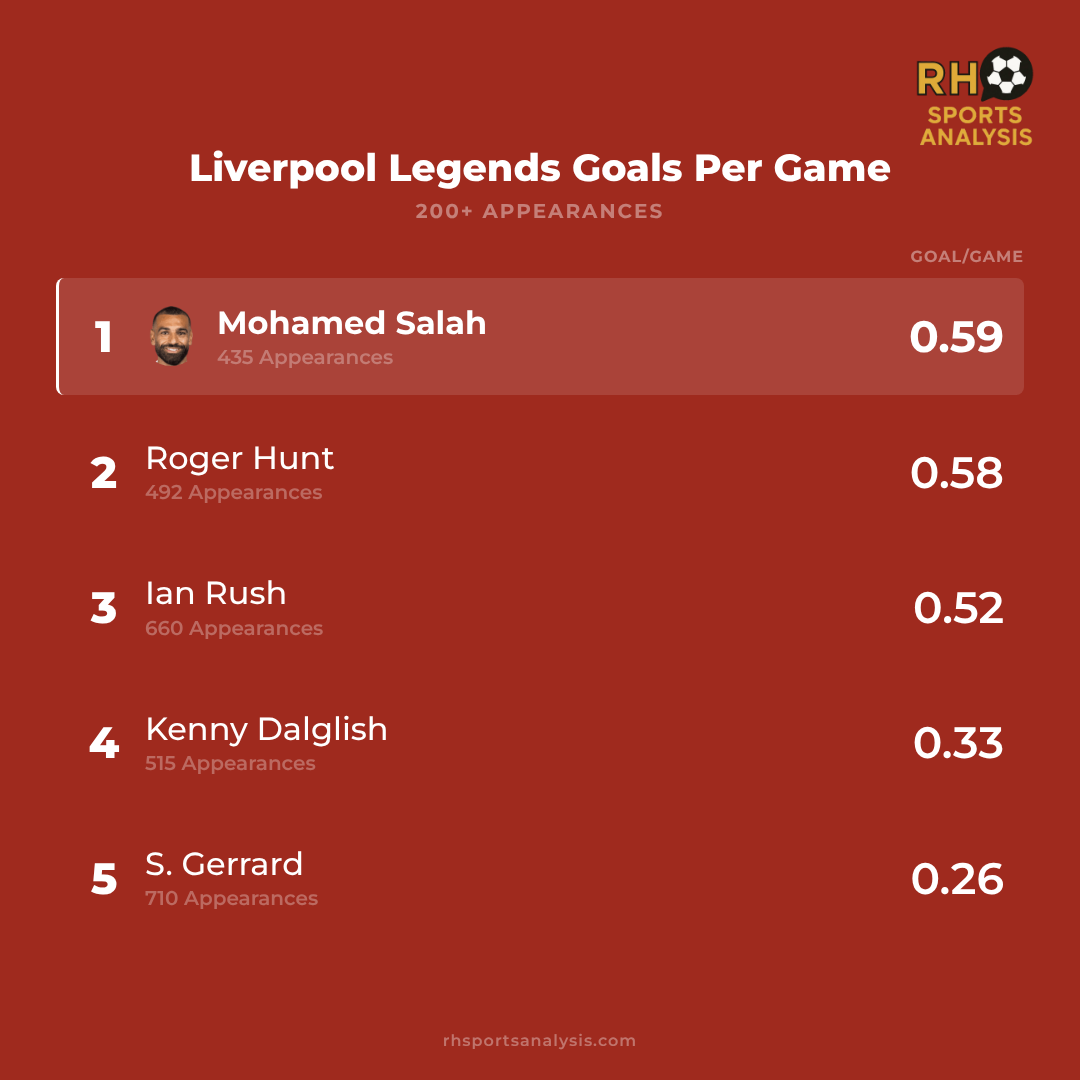
The raw numbers place Salah third on Liverpool's all-time scoring list, behind Ian Rush (346 goals in 660 appearances) and Roger Hunt (285 in 492). His goals-per-game ratio of 0.59, however, is the best of any Liverpool player with more than 200 appearances, comfortably surpassing Hunt's 0.58 and Rush's 0.52.
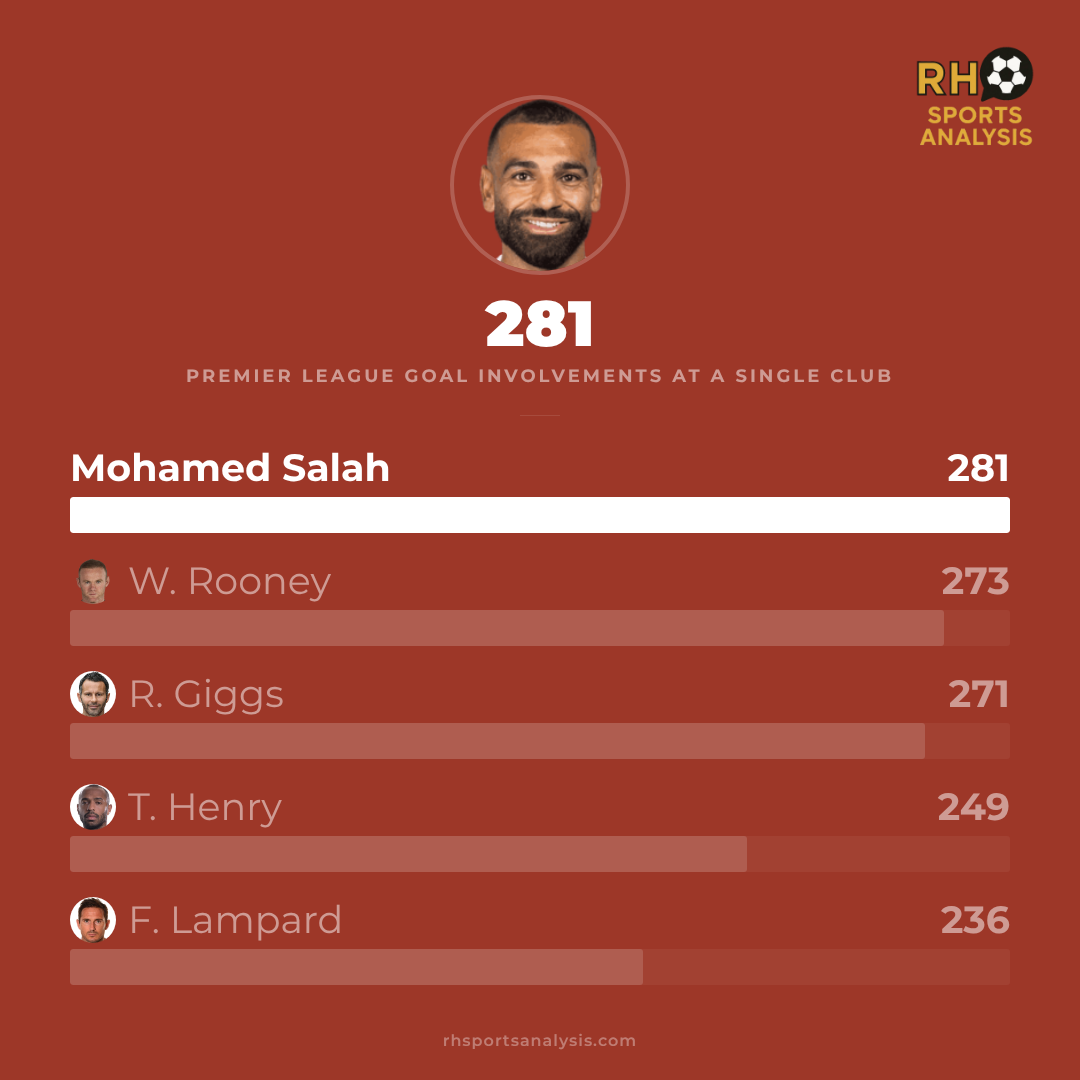
Among Premier League all-time scorers, he sits fourth with 191 goals, behind Alan Shearer (260), Harry Kane (213), and Wayne Rooney (208). His 281 Premier League goal involvements for Liverpool surpassed Rooney's 273 for Manchester United, making him the most productive player at a single club in the competition's history.
The comparisons with Liverpool's greatest players are instructive. Steven Gerrard played over 700 games and scored 186 goals but never won a league title. Kenny Dalglish won six league titles in an era before the Premier League but scored 172 goals across 515 appearances. Luis Suárez's 0.62 goals-per-game ratio at Liverpool was marginally higher than Salah's, but from 133 appearances rather than 435, a sprint rather than a marathon.
Salah is the only player in that group to have won the Premier League with Liverpool, and he did it twice. He is the only one to have won four Golden Boots. He is the first player in the history of the PFA award to win Players' Player of the Year three times. The individual accolades accumulated across eight seasons at a rate that no wide forward in English football has matched.
What makes his case unique among Liverpool's legends is that his peak productivity arrived so late. His 71 Premier League goals since turning 30 are more than Alexis Sánchez, Phil Foden, or David Silva scored in their entire Premier League careers. The conventional career arc says wingers decline sharply in their early thirties. Salah produced his single best season at 32.
The final act
Salah's final home game against Brentford on 24th May will be a celebration of 255 goals and an era that brought a Champions League, two Premier League titles, and a level of individual excellence that Anfield had not seen since the 1980s. There is still a Champions League quarter-final second leg against PSG on 14th April, trailing 2-0 from a first leg in which Salah watched the entire 90 minutes from the bench.
The genius was real, but it was never just individual. It was the product of a collaboration between player and system that English football may not see again.
Salah was not a player who happened to score a lot of goals at Liverpool. He was the product of a system specifically designed to put him in the positions where his finishing, his movement, and his intelligence could do the most damage. When that system was intact, the output was superhuman: 47 goal involvements in a single season, the most productive club-specific career in Premier League history, a goals-per-game ratio that matched the best strikers who ever played in England. When it eroded, so did the output, not because Salah declined as a footballer, but because the architecture around him was no longer there.

Klopp understood this better than anyone.
“I couldn't have imagined that something like this was possible.”
— Jürgen Klopp on Salah's departure
Neither can the numbers.
Related reading
Liverpool vs Chelsea Preview: Salah's Final Anfield Date, Champions League at Stake & Pedro's Lone Threat
Liverpool vs PSG Preview: Slot Dropped His Best Player and Got Nothing, Now Salah Gets One Last Anfield Night
Our members receive data-driven selections across every sport we cover. Are you in?