




Harry Maguire Says He's One of the Best in the World. We Checked.

Harry Maguire sat in front of the cameras at Carton House in Maynooth, County Kildare, on the 9th of April 2026, a day after signing a new contract with Manchester United, and said what nobody expected him to say. “I still believe, even at my age, I'm arguably one of the best defenders in the world in both boxes,” he told BBC Sport's Simon Stone. “I don't think that's in question really.”
It was not a throwaway line buried in a longer answer. He said it to the BBC, to The Athletic, to The Telegraph, to ESPN, across a full media round that covered everything from the World Cup to Wayne Rooney to what the last few years nearly did to him. The quote travelled further than anything he has said since the Mykonos trial, and the reaction was exactly what you would expect. But the interesting question was never whether people agreed with him. The interesting question is whether the numbers do.
So we tested it. We took five centre-backs who would feature in any serious conversation about the best in the Premier League this season: William Saliba, Gabriel Magalhães, Rúben Dias, Virgil van Dijk, and Marc Guéhi. We pulled every stat from every Premier League appearance for all six players this season, cross-referenced the advanced metrics, and asked a simple question.
Is Harry Maguire one of the best defenders in the world in both boxes?
The sample size matters
Before anything else, the context. Maguire has played 1,205 Premier League minutes across 18 appearances this season, only 14 of them starts. Van Dijk has played 2,880 minutes across 32 starts, every single league match Liverpool have played. Gabriel has 2,256 minutes, Guéhi 2,520, Saliba 2,165, Dias 2,051. Put simply: Maguire has barely half the minutes of anyone else in this comparison.
That does not invalidate the comparison, but it frames it. Stats averaged per 90 minutes wobble more when you have fewer minutes to work with. Maguire has the equivalent of 13 full matches to draw from. Van Dijk has 32. One bad game moves the needle more. One dominant afternoon inflates the averages. Where Maguire leads a category, the caveat is always there. Where he trails, the gap is usually large enough that sample size alone cannot explain it.
His own box: where the claim has legs
If you define “best in both boxes” as narrowly as Maguire presumably means it, as aerial dominance and physical presence in and around the penalty areas, the defensive half of the equation is real.
0
Aerial duel win percentage this season. The highest of any centre-back in this comparison.
Defensive duels this season
| Player | Aerial win % | Tackle success % | Duel win % |
|---|---|---|---|
| H. Maguire | 77.0 | 69.2 | 70.9 |
| V. van Dijk | 74.6 | 59.1 | 75.0 |
| M. Guéhi | 68.9 | 63.2 | 64.8 |
| Gabriel | 66.9 | 51.5 | 69.3 |
| R. Dias | 64.4 | 42.9 | 60.7 |
| W. Saliba | 54.8 | 58.1 | 57.1 |
Maguire wins 77% of his aerial duels this season. That is the best of the six. The gap to Saliba, who anchors the best defence in the league, is a full 22 percentage points. In the air, he is genuinely elite.
His tackle success rate leads the group too, although Dias's figure is distorted by a tiny sample of just 14 tackles all season. On overall duel win percentage, Maguire sits second only to Van Dijk. When he engages, he wins. That much is not up for debate.
Thomas Tuchel said as much when he recalled Maguire to the England squad in March 2026, gave him the armband for the second half against Uruguay at Wembley, and then publicly ranked him fifth in his centre-back pecking order behind Konsa, Guéhi, Stones, and Chalobah. “I got exactly what I thought,” Tuchel said afterwards. “Solid, solid central-defender play. That's what he does. Very good on the ball, very calm, strong in the air and is the weapon for set-pieces.” Even while placing four players ahead of him, the England manager acknowledged that Maguire's physical qualities are distinct.
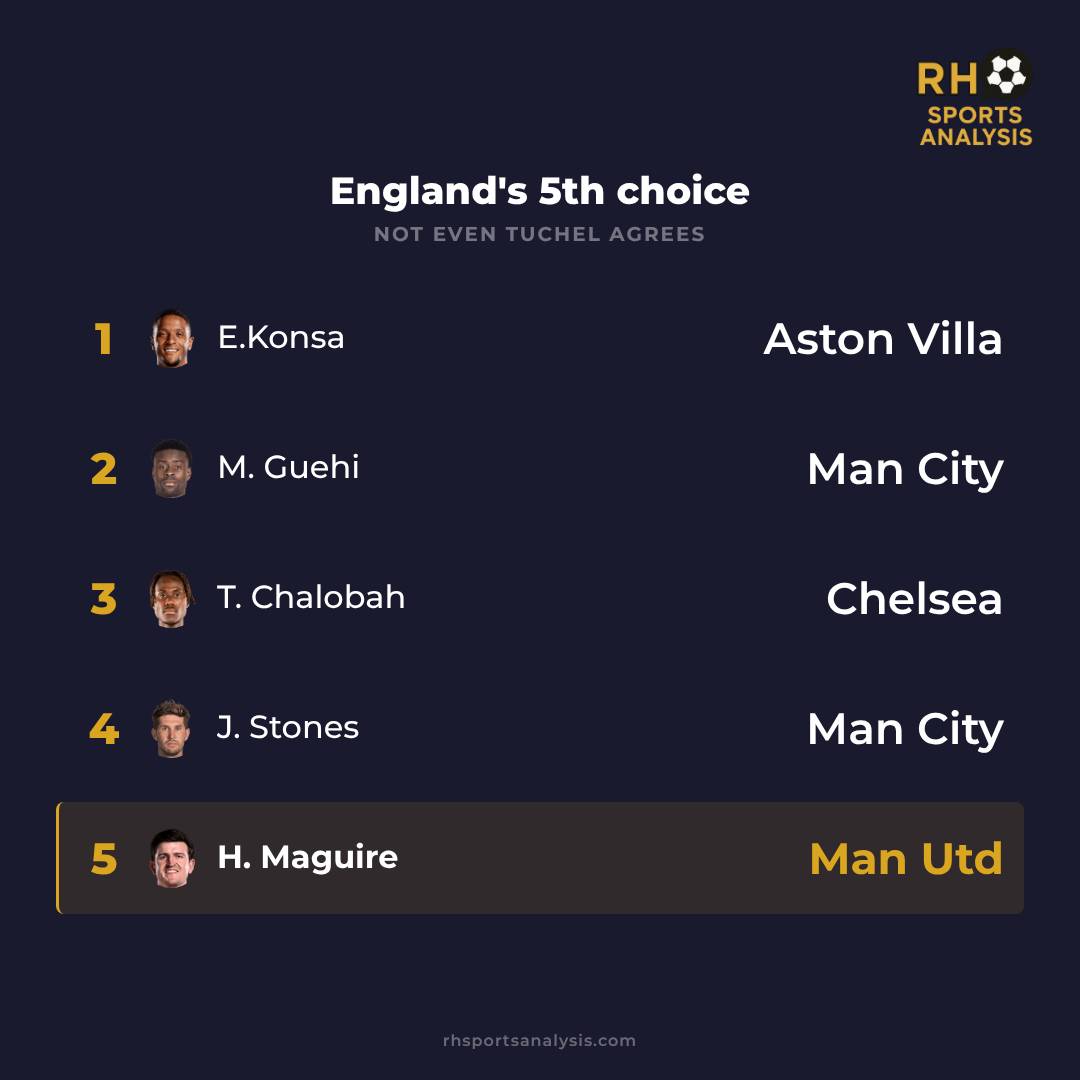
“He has an asset that can also be super-important in a tournament, in knockout football, in defending a lead and chasing a game with crosses and long throw-ins and set-pieces.”
— Thomas Tuchel
Clearances and blocks tell a similar story. Van Dijk and Gabriel lead on both counts, and Maguire sits in the middle of the group. This is a defender who deals with danger. He heads it away and puts his body in the path of the shot. In his own penalty area, against crosses and set pieces, Maguire is effective. The numbers confirm it.
Clearances & blocks per 90
| Player | Clearances | Blocks |
|---|---|---|
| V. van Dijk | 7.47 | 0.72 |
| Gabriel | 6.14 | 1.04 |
| H. Maguire | 5.38 | 0.60 |
| R. Dias | 5.05 | 0.75 |
| M. Guéhi | 4.89 | 0.64 |
| W. Saliba | 4.41 | 0.21 |
The ball at his feet: where the claim falls apart
Modern centre-backs do not just defend their own box. They build from the back, they carry the ball into midfield, they set the tempo of their team's possession. On every metric that measures this, Maguire is last.
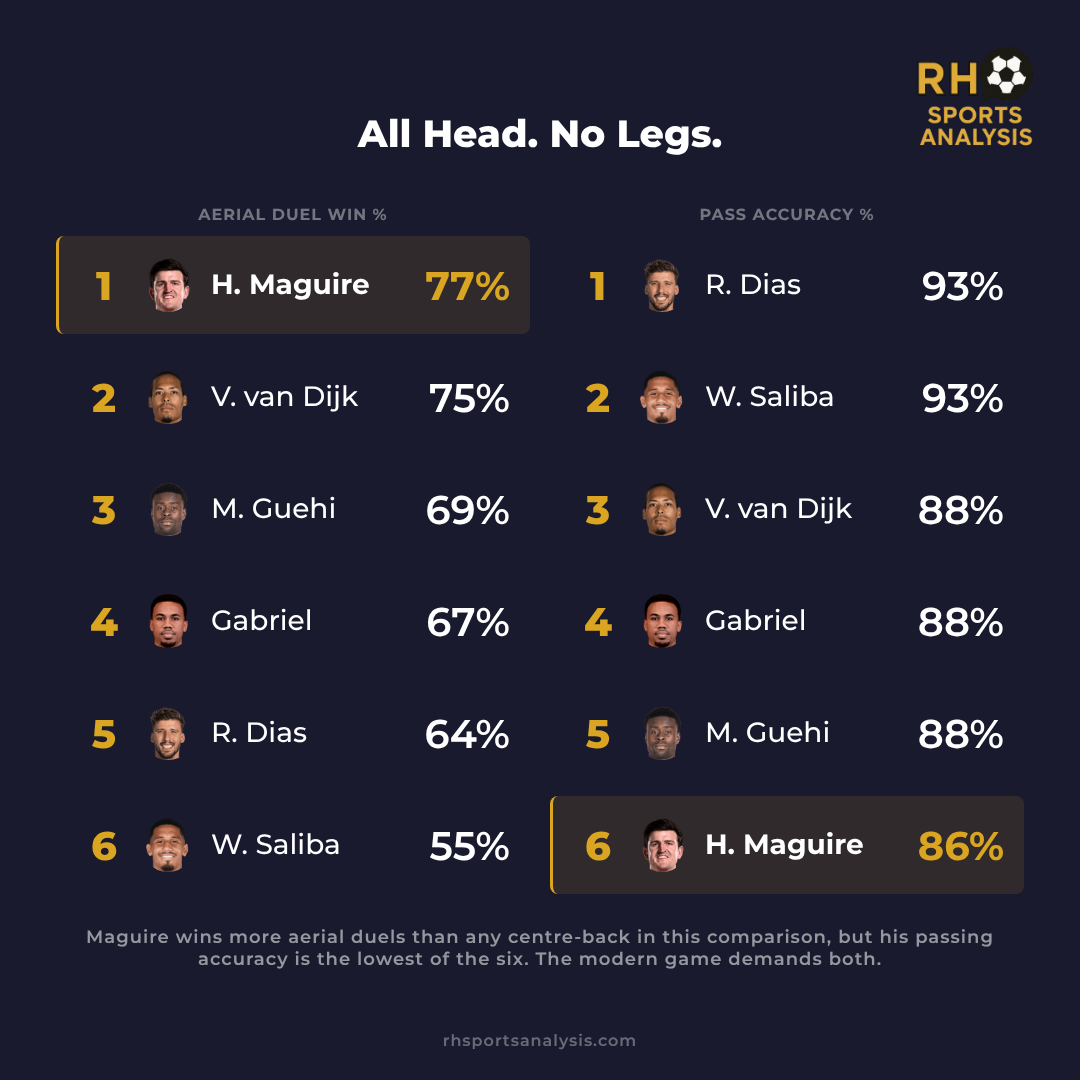
His pass accuracy is 86.4%. Dias completes 93.0% of his passes. Saliba sits at 92.7%, Van Dijk at 89.2%, Gabriel and Guéhi both at 88.3%. The gap between Maguire and the top of the group is nearly seven percentage points, which across a full season translates to dozens of additional turnovers. His 47.95 passes per 90 are the fewest of the six by a distance, with Dias (74.07) and Van Dijk (74.94) attempting more than fifty percent more. His touches per 90 (58.93) confirm that he is simply less involved in the game than any of the comparison group, where the next lowest is Gabriel at 71.93.
The reason Tuchel named four centre-backs ahead of Maguire was not a mystery. “I see other players ahead with a different profile,” he said. “I see Trevoh Chalobah, on the level of mobility, was slightly ahead of him.” Mobility in this context is not just pace. It is the ability to receive possession under pressure, to step into midfield, to compress the distance between defence and attack. Maguire's on-ball numbers reflect a defender who plays behind the game rather than through it.
Guéhi's numbers illustrate the point neatly. At Crystal Palace, his pass accuracy was 85.3%, broadly similar to Maguire's. At Manchester City, since his January transfer, it jumped to 93.2%. Better teammates, better systems, and better positioning options transform a centre-back's on-ball output. Maguire has played his entire United career in dysfunctional systems under five different managers, and the passing numbers reflect it. But you cannot claim to be one of the best in the world and then point to the system as the reason the numbers do not back you up. The other five manage to produce elite passing figures regardless.
The other box: good, not great
The second half of “both boxes” is the attacking penalty area, the set-piece threat that Maguire has built his reputation on. The header at Anfield in October 2025, the goal against Sweden at the 2018 World Cup, the towering presence at corners that makes him a genuine weapon.
This season, Maguire has one goal and one assist in 18 appearances. Gabriel Magalhães has three goals and four assists in 26. Van Dijk has three goals in 32. Gabriel's goal contribution per 90 is nearly double Maguire's. In the opposition box, Maguire is useful. Gabriel is elite.
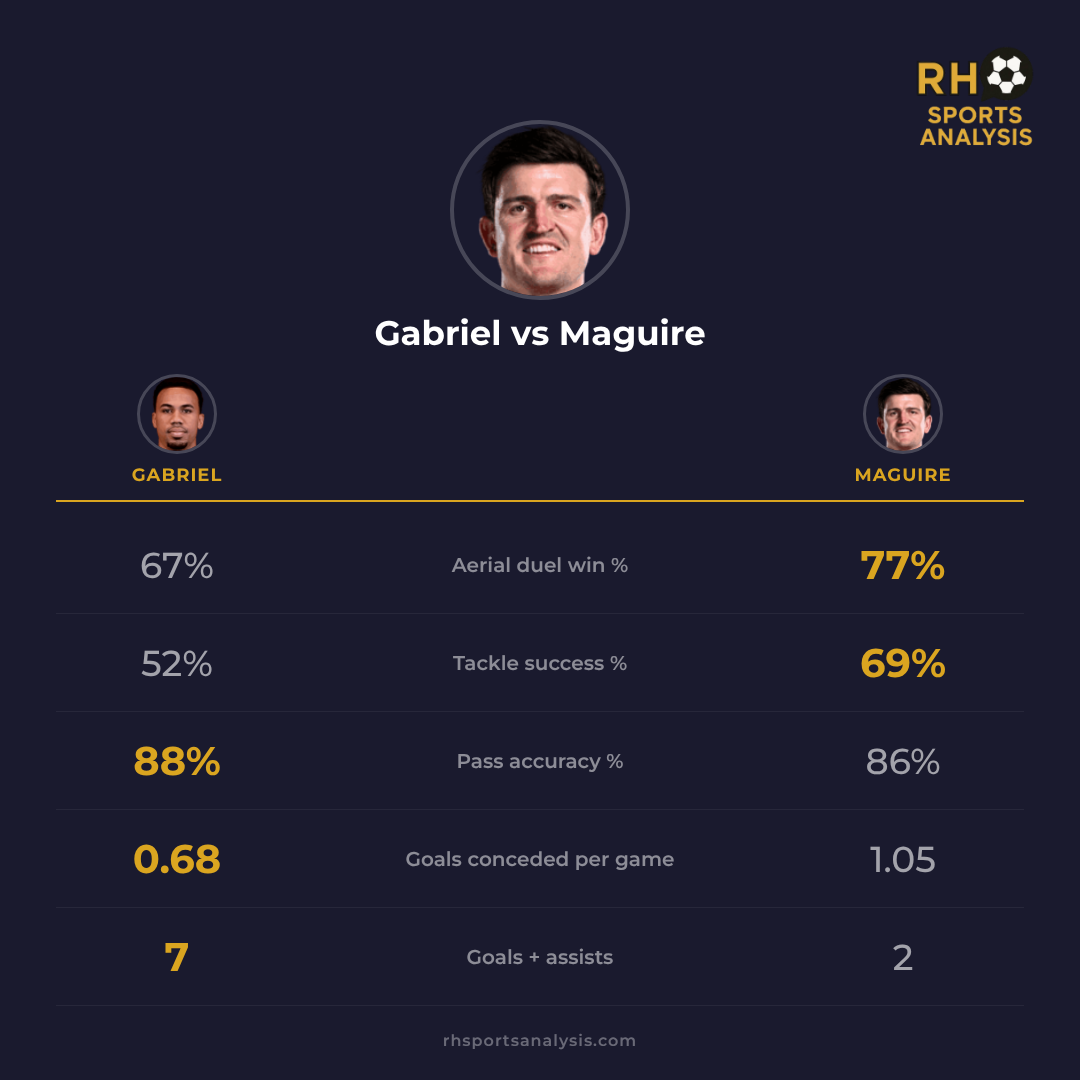
The aerial numbers that serve Maguire so well defensively should, in theory, translate to the other end. He wins his headers. But winning headers at set pieces requires service, positioning, and the frequency of opportunity that comes with playing every week. Maguire's 14 starts mean fewer corners defended, fewer free kicks attacked, fewer moments to impose himself. The per-90 numbers adjust for minutes but cannot adjust for the rhythm and confidence that comes with consistent selection. Still, one goal and one assist in 1,205 minutes is not “one of the best in the world” territory by any definition.
The number that kills the argument
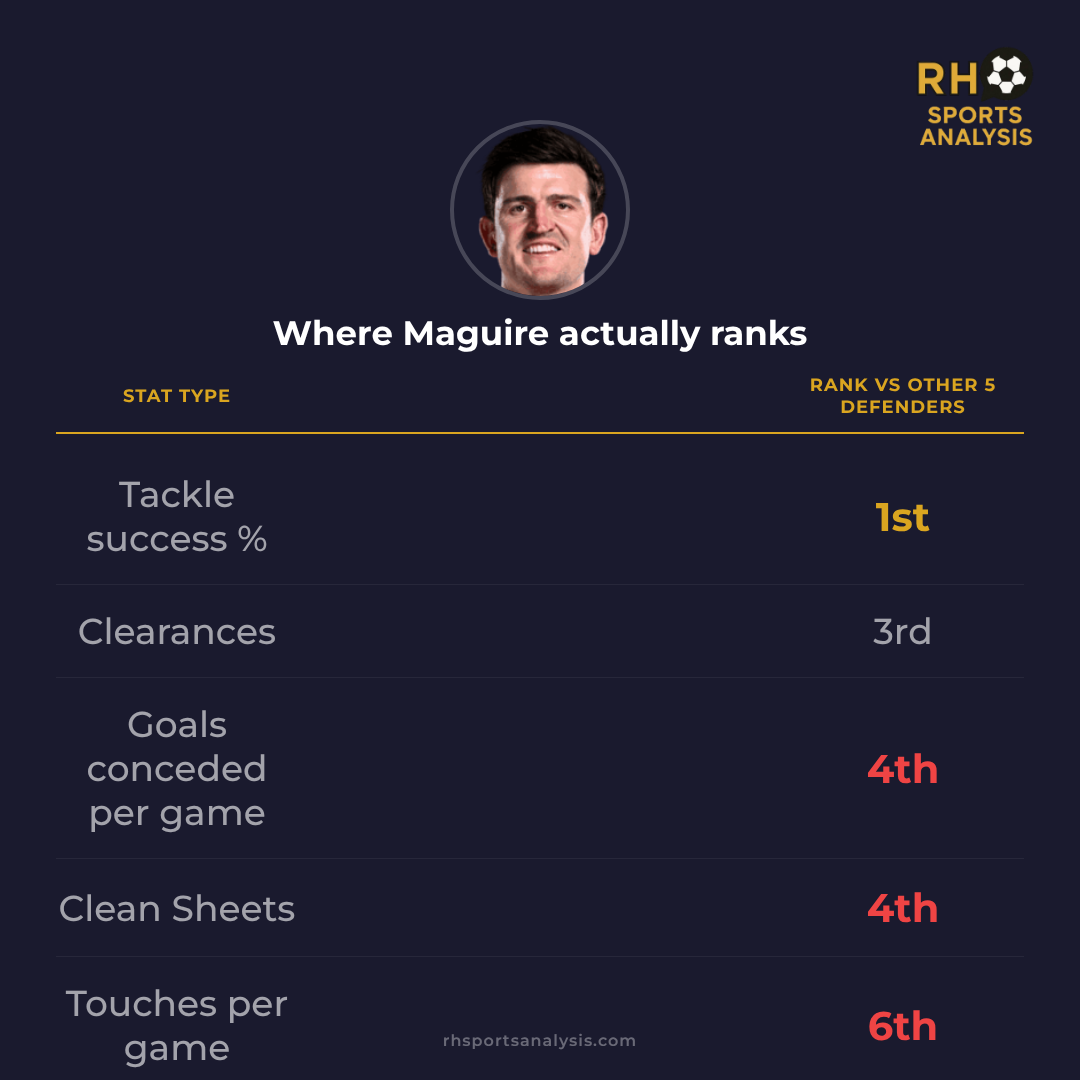
Goals conceded per 90 minutes. The single metric that captures, however imperfectly, how well a defence functions when a given centre-back is on the pitch. Maguire concedes 1.05 goals per 90 this season. Gabriel concedes 0.68. Saliba concedes 0.75. Dias concedes 0.88. Only Van Dijk (1.31) and Guéhi (1.07) are worse, and both have mitigating context: Liverpool's defensive issues have been well-documented all season, and Guéhi spent 20 games at a Crystal Palace side who concede for fun before moving to City in January.
0
Goals conceded per 90 minutes. Fourth of six, behind Gabriel (0.68), Saliba (0.75), and Dias (0.88).
Manchester United have conceded 44 goals in 31 league games this season, a rate of 1.42 per match. Arsenal, whose defence is built around Saliba and Gabriel, have the best defensive record in the league by a comfortable margin. Manchester City have conceded 31 in 32. Maguire is the first-choice centre-back at a club whose defence leaks more than a goal a game, while the defenders he is comparing himself to play behind the two tightest backlines in the country.
Clean sheet percentage is similarly revealing, but it needs honest handling. Maguire has eight clean sheets in 18 appearances, a headline rate of 44%. Three of those eight came in cameos of ten minutes or fewer against Fulham, Sunderland, and Arsenal. Strip those out and the figure drops to 36% in matches where he actually played a half or more. That sits ahead of only Van Dijk. Presenting the raw 44% without that context would be doing exactly what this piece is designed not to do: inflating the numbers to fit the narrative.
Clean sheet percentage
| Player | Clean sheet % |
|---|---|
| Gabriel | 58% |
| W. Saliba | 54% |
| R. Dias | 48% |
| H. Maguire | 36% |
| M. Guéhi | 36% |
| V. van Dijk | 31% |
Maguire adjusted for appearances of 60 minutes or more
The consistency gap
The match-by-match data is where the argument collapses entirely. Gabriel Magalhães has one match rated below 6.50 all season, a 6.31 in the 3-2 defeat to Manchester United at the Emirates in January. His floor is higher than Maguire's average. Saliba's lowest rating is 6.36. Van Dijk has dipped below 6.40 only twice in 32 matches.
0
Matches rated below 6.00 this season. Gabriel has zero.
Maguire has three matches rated below 6.00. A 5.77 against Manchester City in September, playing just 28 minutes off the bench. A 5.79 against Bournemouth in March, the match that ended with a red card. The Anfield performance (7.48, eight clearances, five aerial duels won, the winning goal) sits at the other end of the spectrum, the best individual display of his season and one of the best by any centre-back in the league this year. But one performance is exactly that. Gabriel has 14 matches rated 7.00 or above. Maguire has seven in roughly half as many games. The elite centre-backs in this league perform at a high level almost every week. Maguire performs at an elite level sometimes and at a below-average level more often than any of the comparison group.
Why he believes it
“I have great self-belief, more importantly, that I'm a top player. That's what helps me when things are tough.”
— Harry Maguire
None of this means Maguire is deluded in the way the memes suggest. There is a reason he sat in that press room and said what he said, and the reason is that self-belief has been the only constant in a career that should have broken him several times over.
In August 2020, he was arrested on Mykonos after an altercation that began when his sister was allegedly injected with a substance. He was convicted of aggravated assault, resisting arrest, and attempted bribery, a conviction he has appealed and continues to contest.
In March 2022, England fans booed him at Wembley during a friendly against Ivory Coast. Gareth Southgate called it “a joke, an absolute joke.” Three weeks later, an email threatened to plant a bomb at his family home. Police deployed sniffer dogs. His mother received abuse on social media that went far beyond football. His every mistake became a viral clip, his name a punchline, the £80 million transfer fee a weight around his neck that no performance could shift.
In July 2023, Erik ten Hag stripped him of the captaincy. He responded with a statement on social media that was dignified and direct: “Whilst I'm personally extremely disappointed, I will continue to give my all every time I wear the shirt.” He was booed again during pre-season in Dublin weeks later. He missed Euro 2024 through injury. For long stretches of 2023 and 2024, he barely played.
And then Michael Carrick walked through the door.
Carrick took charge on the 13th of January 2026, with United seventh in the table and drifting. He switched to a back four, restored Maguire as first-choice centre-back, and watched his team climb from seventh to third. Maguire has started every Premier League game under Carrick.
“He's the most patient man in football.”
— Sam Allardyce
Good enough to keep going, not good enough to be the best
The numbers are clear. Harry Maguire is not one of the best defenders in the world. He is not one of the best defenders in the Premier League. Among the six centre-backs in this comparison, he ranks first in aerial duel win percentage and tackle success rate, and last in pass accuracy, touches per 90, and passes per 90. He is fourth in goals conceded per 90, and his match-by-match ratings show a level of inconsistency that the elite defenders in this group simply do not have.
What he is, unambiguously, is a good Premier League centre-back having the best season of his late career under a manager who trusts him. He is a set-piece threat at both ends, a physical presence in both penalty areas, and a genuinely elite aerial duel winner. Tuchel was right when he said Maguire could be “super-important” in tournament knockout football. That is a real and specific value.
But “super-important in knockout football as a set-piece weapon off the bench” is not the same claim as “one of the best defenders in the world in both boxes.” The first is supported by the evidence. The second is not. Gabriel Magalhães, the centre-back who leads this comparison on goals conceded per 90, clean sheet percentage, goal contributions, and blocks per 90, does not make that claim. Saliba, who has anchored the best defence in the league at 25, does not make that claim. Van Dijk, the only centre-back in the group with a higher overall duel win rate than Maguire, does not make that claim.
Maguire does. And maybe that is the point. Maybe the man who survived Mykonos, and the bomb threat, and the boos at Wembley, and being the most mocked footballer on the planet for the better part of three years, needs to believe he is the best in the world to keep walking out there. Maybe the claim is not a factual statement to be verified but a declaration of intent from someone who has earned the right to be unreasonable about his own ability. The data says he is wrong. His career says it does not matter.
He is 33 years old, he just took a pay cut to stay at a club that nearly destroyed him, and he wants one more World Cup. If he gets there, it will not be because the numbers say he deserves it. It will be because he refused to believe they applied to him. That has always been the Harry Maguire story.
Related reading
Casemiro: Reborn, and Leaving
Manchester United vs Liverpool Preview: Carrick's Audition, Liverpool's Third-Choice Keeper & Bruno's Record Chase
Our members receive data-driven selections across every sport we cover. Are you in?